Thank goodness for people like Rhoda Kadalie. As an Afrikaner I was outraged by the abusive Reitz video made at the Free State University. So was many other Afrikaners and Afrikaner organisations.
But simmering all week was a nagging feeling that the way this has been criticised from certain quarters is so disproportionate when compared to other incidents. This hypocrisy in itself reeked to me of prejudice. Some commentators like Michael Trapido have spotted the same.
The reaction of celebrity South African society and the international media is unquestionably disproportionate when compared to other incidents in this country, and now it seems some organisations like Cosatu and the ANC are trying to make political capital from it.
I don't for a moment think lambasting these students for arrogant racist abuse and taking strong disciplinary action against them is unwarranted. Neither don't I think the University management at the UFS should take stock of how they deal with racism and change its structures if it must. But can we have similar for all abuse suffered by different groups in this country, on campuses and off it?
And, yesterday Rhoda Kadalie said exactly that in a hard hitting article Video uproar betrays culture of double standards.
Take violence against women at our Universities says Kadalie."...we forget that sexual violence and rape are prevalent and covered up on so many campuses. Ask me, I know about sexual violations at so-called progressive universities, where student leaders were involved in the sexual harassment and rape of fellow students. These campuses were not billed as “campuses of rape”, and whole campuses are not painted with the same brush because of those who routinely perpetrate such acts of violence against female students at only one."
What is Rhoda referring to? To these reports of rape at a Durban campus? Perhaps, who knows, because besides this report very little else was written about this particular incident or any others. It certainly did not reach the Sowetan, The Star, Die Beeld, The Sunday Times etc.
Perhaps because it has a female editor The Mail and Guardian gave a UKZN lecturer Lubna Nadvi the opportunity to write a further article on the rapes at the UKZN campus.
For her trouble the newspaper got a stinging rebuke from the university management including the deputy dean, Professor Nceba Gqaleni accusing Nadvi of racism. Incredibly the report was attacked because there had been none before on other similar incidents:“A number of African students have died or been mugged in residences.”
And there had been no media coverage he said.
Ferial Haffajee, the Mail and Guardian editor sprang to Lubna Nadvi's defence:“A number of African students have died or been mugged in residences.” The writers throw in this statement as evidence of Nadvi’s alleged racism and charge that she only cared when an American student was raped, not because it is deeply shocking that places of learning have become places of horror.
Shocking yes, but still the story barely registered at home or abroad.
But shocking events ignored is par for he course it seems. Kadalie goes on and lists racism and abuse by black South Africans that go unreported or that spectacularly fails to rack up the column inches:Equally, at many predominantly black universities, racial segregation at residences is the order of the day, but nobody speaks about that because it is assumed here that freedom of association is a right . Do you remember the coloured man who moved into Khayelitsha and was hounded out by blacks for daring to go and live in a black area?
You probably don't remember it, but there was a report of the coloured man's whose house was stoned by a crowd of 400 people.
But this of course is small fry compared to the xenophobia foreign blacks encounter in this country and often pay for with their lives. Kadalie again: And how many hundreds of Somalis in Western Cape have been killed by other black people for simply being successful business people? Where are the headlines about this? Where is the Human Rights Commission when it comes to taking up these plights?
Here is one account of the suffering of Somalis at the hands of Xhosa's in Masiphumelele Visoek.
Kadalie is however wrong. The killings of Somalis is a country wide phenomena and not limited to the Cape. Attacks on Somalis have been recorded in Knysna, Stellenbosch in the Western Cape, Uitenhage in the Eastern Cape, Diepsloot in Gauteng and Khutsong in the Free State, among others.
The first death was in 1997. Jacob van Garderen the new director of Lawyers for Human Rights have been dealing with cases of Somalis killed in Parys in the Free Sate as well. There have been no news reports of these killings in Parys whatsoever.
In October 2006 as many as 40 Somalis were killed in one month, and all we have to show for it is this article by Pearly Joubert. Where is the international media?
I could list more instances of abuse where the international media peculiarly let South Africa off the hook. Compare this to what happens elsewhere. Russia is regularly in the news when racist attacks take place where individuals are hurt or killed. In another article the BBC follows up on a Amnesty International report that as many as 28 people could have been killed in Russian racist attacks during 2005.
When a polish immigrant Robert Dziekanski, recently was tazered to death by police in Canada the world was aghast.
When Adonis Musati, a young Zimbabwean asylum seeker died of hunger, a few meters away from the department of home affairs on the glitzy Cape Town foreshore, after he had queued there for days, there was barely a whimper. It did not register internationally.
Very recently The Sunday Times commissioned research from Plus 94 Research on racism in this country. Futhi Ntshingila reported on the front page of the Sunday Times that most black South Africans experience other black South Africans as most racist. The poll found that Indians were the most likely recipients of racial hostility from Africans, with three out of four Indian respondents claiming first-hand experience of this.
The sentiment was most obvious in Durban and academic and activist Ashwin Desai said this was not surprising. “You tend to compare yourself with somebody across the road from you. Therefore the conflict between Africans and Indians happens ironically in places where they live next to each other,” he said.
A scintillating story and controversial to boot, but well researched and including some excellent commentary and analysis from the likes of Professor Adam Habib, Dan Ncayiyana, activist Ashwin Desai and Professor Charles Villa-Vicencio.
I challenge you to try and saddle up Google and find the original story on the Sunday Times website or any follow ups by any other media organisation. The only reference to the original story is to be found on a sad right wing website, where it has been copied and pasted wholesale.
Why do we suffer from this two faced reporting? Why this hypocritical public gushing and regurgitating on the one hand and conspiracy of silence on the other? The world and we have our South African narrative fixed and we won't let facts get in the way of our emotional reaction.
For lack of a better word I will call it apartheid reporting, because that is exactly what it is. There are two sets or moral codes operating in South Africa.
The consequences of these lopsided reactions is to encourage Afrikaner denialists of racism. Because agreeing is seen as giving carte blance for the rising new wave of prejudice, sweeping all in 'transformative' path.
Should we condemn Reitz less? No. But lets take up the cudgels elsewhere where people are abused and killed. This is after all about human rights and not persecution, right?
Friday, March 14, 2008
Apartheid morality, one for Afrikaners and one for the rest

Friday, September 01, 2006
60 Somalis allegdedly killed in Cape Town
About 60 Somalis have been killed and another 15 injured in the Western Cape in the past two months in a deliberate attempt to chase businessmen from the African country out of Cape Town’s townships, according to the Somali residents.
Sphere: Related ContentTuesday, May 13, 2008
Racist attacks in Johannesburg
The news of yet more xenophobic attacks and killings in Johannesburg is sad, but part of a familiar pattern . The only silver lining this cloud has is that the press both locally and internationally has at last picked up on the race riots.
Here is a Voice of America radio report. And that of the International Herald Tribune.
And so its should, this act is far worse than what happened at the Reitz hostel. In reaction to Xolela Mangcu's denial and attack on white racism who said recently:
"But right now, racism is not a black people’s problem, ridiculous charges of reverse racism notwithstanding."
I wrote this:
I spent a month in Yeoville recently and many black South Africans admitted brazenly - in a manner that would raise an eyebrow in a Ventersdop kroeg - that they were going to wipe out all the African foreigners there. We must just wait and see I was told.
Anybody in doubt about the seriousness should read this report. Or this one where one where Yvonne Ndlovu from Zimbabwe was taunted by four women to go home while blood was streaming from her face. A Malawian who had lived in Alexandra for 25 years was also beaten up. One Zimbabwean women was raped four times.
According to The Times, in an act resembling the passover, terrified South Africans have started to mark their shacks with South African names like, Madondo, Ndlovu, and Masinga.
Three persons are confirmed dead, and the chief executive at the Alexandra clinic, Abel Mangolele, said that between Sunday night and Monday morning alone 58 patients had been brought in with injuries sustained during the attacks.
He said an additional 56 were brought in on Monday and a further 39 were brought in for treatment between Monday night and Tuesday morning.
Last night I found the website of the Somali Association of South Africa, it cronicles the violence foreigners faced in South Africa.
The association claims that more than 100 Somalis have been killed in South Africa the last few years.
Cosatu and the SACP has come out strongly against these attacks. On its Allmostsupernatural, a South African Jewish site, these attacks are condemned. I hope that organisations representing other minorities (like Afrikaners) will do the same.
Pictures: News 24
Friday, October 20, 2006
Comrade + oppressor = compressor
Mhambi, attended a breakfast hosted by the Sociology of work unit (SWOP) at Wits university. Here research of declining solidarity at the National Union of Mineworkers (NUM), South Africa's largest union, were presented. The reasons given were ethnic conflict, corruption, increased outsourcing, and shop stewarts drawn into management structures (the compressors). NUM commisioned the research and should be congratiolated for being so open.
Talking of compressors of a different kind, the BBC has finally reported on the murder of Somalis in Cape Town by local business men. Mhambi has it on good authority that its taking place country wide, especially in the Free State province.
Here are the official figures of asylum seekers in South Africa (2004).
DR Congo 9,516 refugees and 4,622 asylum applications
Somalia 7,118 refugees and 3,893 asylum applications
Zimbabwe 5,789 asylum applications
Ethiopia 2,795 asylum applications
Angola 5,774 refugees
Burundi 2,075 refugees
Rwanda 1,266 refugees
Tuesday, January 29, 2008
Mhambi's South Africa 2007
Mhambi is very late with this posting, my summary of Mhambi 2007.
Last year I described 2006 as a watershed year for South Africa in my posting Mhambi's 2006. A year in which open debate returned to South Africa.
If you remember, as Steven Friedman explained, this was not because of a new found commitment to democracy amongst our ruling political class, but because of the battle for control of the ANC and the state between the Mbeki and Zuma camps.
So 2007 started off with many of these 2006 debates carrying into the new year. In these debates Xolela Mangau was one of 2007's most acerbic and eloquent voices against creeping country wide corruption. Others like Rhoda Kadalie waded in.
Steeds De la Rey
There were more heated exchanges at the beginning of the year about the De la Rey song. What did it mean? What would it bring?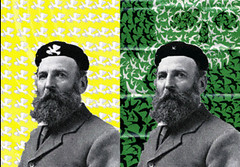
Leeu van die Wes Transvaal
Originally uploaded by Wildebeast1.
Tim du Plessis changed his mind (and not for the last time in 2007) . In 2006 he warned of deliberate Afrikaner civil disobedience, but now announced the arrival of a more confident participatory breed: the New Afrikaner. Pallo Jordan, the minister of Arts and Culture, warned against De la Rey song inspired treason.
The song reached the press in both the UK and US. And in the process it served as an amusing outing of international prejudices about Afrikaners.
But nowhere was its meaning as debated as among Afrikaners. Lefty journo Max du Preez saw in it the worst: racism, atavistic nationalism, a longing for the past. But poets and writers Antjie Krog, Koos Kombuis were not convinced with that line of argument.
But before you think South African 2007 debates were dominated just by a pop song. They were not. By years end it was out of the news completely.
In the US, a debate raged over what extent apartheid could be compared to current events in Israel.
Angola the country South Africa helped wreck celebrated 5 years of peace.
Britain and racism
Rather arbitrarily the BBC decided to screen a blatantly racist tribute to colonial writer Rider Haggart. Perhaps not surprising as in 2007 it transpired that Britain is a society with little self awareness when it comes to racism.
2007 was a year when racism boiled over on British TV, when Jade Goodie and other white Big Brother contestants ganging up on Indian star Shilpa Shetty. The incident had the country in a tizz. The press especially were aghast, while admitting at the same time that the opinions expressed were prevalent in British society.
Many left commentators defended Goody: she was working class, and more likely to be exposed to multi-cultural Britain than her critics they claimed. A good example was Philosopher Julian Baggini who spent six months living in Rotherham, Yorkshire. In the Guardian he professed that he doesn't believe most white Britons are racists - even though he heard racist language almost everywhere he went.
On the cultural and media front trade union solidarity won the global award for the best union website. Gazelle released a funky a stomping Afrikaans electro track, while two movies cataloging life in gay South Africa, screened in London.
Facebook took the world by storm in 2007. Also in South Africa, despite the privatised national telecoms provider Telcom's parasitic and damaging impact on the countries internet ecosystem.
Bad news aplenty
Bad news about the break down of trust and public institutions came a plenty. Many of which, like the Hlophe affair and the scandalous neglect at the Frere hospital Mhambi never wrote about himself.
Wabenzi
Originally uploaded by Wildebeast1.
I did write about the alleged corruption of the National Health minister, who was not fired, even after it was claimed that she was an alcoholic and a thief. Instead the government tried to muzzle the press. There were other posts of Afro-pessimism. Events like the casual destruction of monuments in Standerton helped to spread the gloom.
The astounding growth of crime and the corruption inside the South African police continued to make waves internationally. Journalists like Jonny Steinberg tried to make sense of the corruption and crime.
In 2007 there were less reports of xenophobic attacks on other Africans by South Africans like which transpired in 2006 when scores of Somalis were murdered. Now the focus shifted to extreme indifference towards other Africans best illustrated by the death of Adonis Musati in Cape Town.
There were valiant attempts from South Africans to reach out to each other, like when Hansie Diffenthal tried to save Halaletsang Nkome.
The Rugby World Cup
But so too did the Rugby World Cup loom large. It became clear that racial make up of the South African Springbok team would be an issue. In fact, the ANC also wanted to change the teams ' iconic name.
As the first big match of the cup approached, between SA and England, the English press went to town with prejudicial reporting: South Africans were stupid and not "every inch Western gentlemen". The verbal barrage did not save the English from a battering on the pitch however.
Neither could the spectre of Che Guevarra help the Argentines against a rampant Springbok side.
Jusr before the final The Guardian published a curious rugby article by Gavin Evans, which was duly pulled apart by readers.
Then, despite all this, the Springboks won. And Mbeki tried to surf the wave of glory. The Bok name became non issue.
Mbeki vs Zuma
He certainly needed it. Such was the the growing opposition to his control freakery that too many it seemed that he would loose the election for ANC presidency the end of the year. That placed many South Africans between a rock and a hard place who wanted neither Mbeki or Zuma in charge. Cyril Rhamaphosa entering the race was one of our great hopes.
Mbeki could and did continue to point out how the economy has grown under his leadership. But doubts remained about his success in addressing poverty.
But his Aids denialism still hung over him like a shadow, with Mark Gevisser confirming and explaining it upon the publishing of his monumental biography of Mbeki. 2007 was also the year in which a minimum number was put to the deaths caused by Mbeki's Aids inaction: 300 000.
Another book, Andrew Feinstein's After the Party, cataloged the ANC's move away from democracy and decent into grand corruption. Mhambi cerealised some of it.
By the end of the year it became clear that Mbeki would hit a wall. Some of us, Mhambi included, were optimistic. The inability of the incumbent holding on to power was that the openness had prevailed, a sign of democracy. And so Mbeki did hit a wall. Karplaks!
Better the devil you know?
Down went Mbeki, and enter stage 'left' Zuma. 2008 will no doubt be as interesting.