Mhambi has been redeployed.

Showing posts with label integration. Show all posts

Friday, May 30, 2008

What happiness science can teach SA on xenophobia

Wealthy people have a greater potential to suffer than the poor.


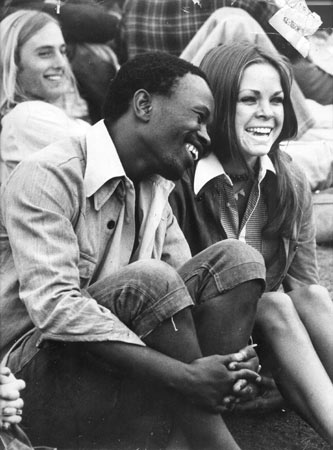
A True Smile
Originally uploaded by ~FreeBirD®~.


Think that statement is controversial? Here is some more:

Being more wealthy than others, and particular your peers, makes you feel happier; Being poorer than others, particular your peers makes people unhappy. One of the greatest sources of happiness are sound relationships.

These and other revelations came from a book I recently read. The book Happiness, Lessons from a new science, from the pen of Richard Layard, a Professor in Economics at the London School of Economics makes claims that will annoy and please left and right wingers alike.

And it makes for interesting insights when applied to South Africa.

The study of happiness in economics is very new but growing rapidly world wide. But why study happiness?

Traditionally, especially in western democracies and Japan, politicians and economists have aimed for maximising economic growth. The argument was that the greater wealth of the population, the greater the feeling of well-being.

For some time now however, economists have noticed that although wealth have increased in the west, levels of happiness have not. In fact in most western countries levels of happiness have actually started to decline even when levels of wealth has grown.

It would seem that once a population reaches a certain level of wealth, becoming richer does not add to a sense of well-being.

Adaptation: As people get used to higher income levels, their idea of a sufficient income grows with their income. If they fail to anticipate that effect, they will invest more time for work than is good for their happiness.

Layard explains that reason why happiness is decreasing in wealthy societies is exactly that in attempts to earn more money, individuals have less time.

And less time means a decline in relationships in general and the quality of relationships. And quality relationships along with good health is one of the prime ingredients of happiness.

Another problem is that earning more often requires individuals to move and settle in different places. This movement and displacement is unsettling and also impacts relationships. It makes individuals unhappy.

A sense of belonging is also central to happiness. This militates against the idea of individuals alone in the big cosmopolitan city.

Layard's research is a strong argument for government intervention to make society more equal. As I mentioned above being poorer than your peers is one of the main causes of unhappiness.

Social comparisons: In contrast to what traditional economics predicts, happiness is derived from relative income as well as from absolute income. That is, if everyone gains purchasing power, some may still turn out unhappier if their position compared to others is worse. This effect may not turn economic growth into a zero sum game entirely, but it will likely diminish the benefits people draw from their hard work. In an economy where not only companies, but individuals are constantly forced to compete with each other, life and work are experienced as a rat race.

But Layard's studies suggests caution:

Loosing what you have, is a greater cause of unhappiness than if you are already poor. A state should therefore be sensitive when introducing re-distributive policies as it can make a part of the population very unhappy.

There are many indicators that in the period 1994 - 2002 South Africans have become poorer. But since 2002 when many socials grants were introduced or broadened, the poor's wealth have indeed increased.

But inequality has increased throughout 1994 to now, and none more so than in between blacks themselves. As the closest peers to poor black SA, the huge difference between rich black SA and poor black SA is a huge potential cause of unhappiness.

There is another key insight Layard provides that might help to explain some of our own xenophobic violence. As I have pointed out, places where the violence broke out were poor, but not the poorest townships in South Africa.

The science of happiness would suggest that once you have a developmental state that looks after the poor, this poor will be less willing to accept outsiders that threaten what they have.

This is wholely consistent with the findings published in the Sunday Times that Mozambiquecans and Zimbabweans are less xenophobic than their neighbours - the relatively wealthy Namibians or South Africans.

Layards research can also be used in other ways to advance the cause of restrictions on immigration. Unstable populations where inhabitants do not know each other, are unhappier places than familiar tight knit communities.

Sphere: Related Content

Monday, April 09, 2007

Democracy is sacrosanct (4)

Come 2008, Liela Groenewald, who was tough enough to square up to Winnie Mandela and the anonymous death threats that followed, left her lovely flat in Yeoville.

Continued from Democracy is sacrosanct (4)

Most of the artists, mucisians and lefties did so too. So what went wrong with Utopia?

Anthony Altbeker again:

"I still loved Yeoville, but by the late 1990s it was obvious that it had not fulfilled the utopian promise its residents had once seen in it. Now there were whole buildings that had gone bad Windowless, lightless and peeling, these were home to a growing underclass of really poor people, among them prostitutes and pimps and drug dealers and thieves. One night, a man was beaten to within an inch of his life in my driveway by a gang of brick-wielding robbers.

We residents consoled ourselves with jokes that celebrated the decay - how could you tell whether the bang you heard was a car backfiring or a gunshot? It's a car if you hear no return fire - but eventually I moved.

After about a decade in the neighborhood, the tipping point came when a man stopped on the road beneath my window late one night and emptied a full clip of ammunition into the air, but I might equally have said in my general direction. Apparently he enjoyed the experience because he quickly reloaded and did it again. Sixteen shots seemed more like a potential massacre than a legitimate way to celebrate a long weekend, and I decided that it was time to get out."


Hillbrow, South Africa
Originally uploaded by gee-raff.


Crime is the reason areas like Yeoville and Hillbrow is lost to the likes of Altbeker, Simpson and Riekert. And Liela, Thulani, Akashni and the ANC MP's. And for that that matter me.

But does it really matter if neighborhoods that sheltered bohemian libetarian culture become dystopian hellholes?

Sphere: Related Content

Saturday, April 07, 2007

Democracy is sacrosant (3)

Continued from Democracy is sacrosant part (2)

No wonder that when the ANC was unbanned in 1990, most of the returning exiles and ANC leadership settled in Hillbrow and neighbouring Yeoville. A coterie of white lefties, both local and from abroad followed.

UK Observer recently remarked: "Yeoville used to be the Greenwich Village of the city: 25 years ago it was the first integration experiment. At the time of the election in 1994 there were 50-odd ANC MPs living here, five or six cabinet members."


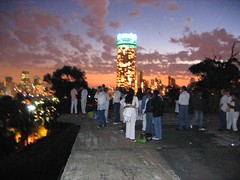
yeoville sunset
Originally uploaded by REPRESENT.CO.ZA.


It was this Hillbrow that Mhambi got to know personally from 1991, when as a student we escaped from the cultural strictures of Pretoria, to taste the exotic freedom and delights of the future. Fellow student Liela Groenewald, later the TRC's investigator tasked with Winnie Mandela's transgressions, often drove to Rockey street's Tandoor with her own pool cue, and wiped the floor with even the most skilled Rasta's.

Come 1996 I had a few friends working with me at the Truth and Reconcillation Commission (TRC) who lived in Yeoville and Hillbrow.

Liela now lived here. There was the beautiful Akashni Singh, the charming and womanising Frank, the bright eyed child of exile Thulani. Half English half Xhosa and married to Mbeki family, he was the Commissions' caring dreadlocked shrink. We sat around in Yeoville's trendy Times Square with the new intelligencia.

But the rot had already set in around us.

Anthony Altbeker, a typical lefty white student of the time describes this well in his fantastic book, The dirty work of democracy.

"It was in Yeoville that I came of age, I moved to Yeoville when I was a naive twenty-year-old. My first flat had a spectacular view of the Hillbrow skyline, and I shared it with a friend who had once been detained for six months in solitary confinement for her activities in the ANC underground.


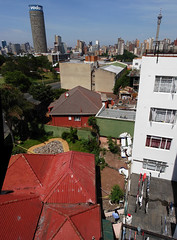
Yeoville Crash Panorama1
Originally uploaded by ismail.farouk.


I did not tell her that our neighbour was a warrant officer in the Riot squad. He moved out within a couple of months, however, and was replaced buy one of the last surviving spliff toking, acid-dropping, heroin using, long-haired hippies of the 1960's, a printer named Ty.

This was the early 1990's and Yeoville was undergoing a profound transformation. Always one of the greyest of Johannesburg's suburbs, the death of aprtheid had seemed an affirmation of the free-wheeling bohemianism of the place. This was where the new South Africa was being born.

Perhaps every 20-something thinks like this, but the world seemed ripe for remaking and we all believed that the seeds planted in Yeoville would soon yield the timber needed to do the job."


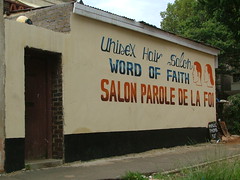
Hair Salon
Originally uploaded by ismail.farouk.


Come 2006, during a 3 month visit to SA I lived very close to Hillbrow and Yeoville, in neighbouring Observatory - and too my shame - in a gated part of Observatory. I drove through Yeoville everyday, and through parts of Hillbrow, but I never set foot there.

Which is why I was should probably not have been surprised when Paul Riekert - one of the rebel artists in the Voelry movement seethed with anger when I mentioned Yeoville. Riekert, now a music producer for the likes of Breyten Breytenbach, and front man of industrial rock band Battery 9 does rage well. Riekert's music has always railed againt the pretty middleclass cozyness of the Cape and celebrated Johanneburg's gritty industrialism. But that he was directing his anger in this new direction said allot I thought.

The BBC reporter Simpson had said it and Riekert agreed: Yeoville and Hillbrow is lost to me he said, "how ironic that an area that thrived with diversity under the Nationalists is now a place where I can not and don't want to go."

This is the same Riekert who as Joos Tondeldoos and with his band Die Dwarstrekkers wrote Vulkaan (Volcano), and album that boomed rightous rage at the old National party. How things had changed.

Sphere: Related Content

Saturday, February 17, 2007

Democracy is sacrosant (2)

This article continues from Democracy is sacrosant (1).

Hippiedom was rife in Hillbrow. Narcotics inspector Fanie had allot to do. But sometimes Fanie had help from zealous citizens. In 1970 on the 10th of October - Krugerday - there were to be a rock festival in Milner park, Hillbrow. Mhambi got some snippets of stories and pics of Hippie Hillbrow on the excellent 3rd ear Music website.


Hillbrow 1975 Photo - Glyn Griffiths (Used without permission)

Now the name of the venue for the concert - Milner park - certainly could not have endeared the Hippies to their attackers. (Lord Milner was the racist English Administrator who instigated the Boer War, oversaw the concentration camps, banned Afrikaans and was a self proclaimed British race patriot.) But is was the terminity of the takhare (longhairs) to organise a rock festival on Kruger day, (heroes day - named after President Kruger who fought the British in the Boer War), that really got their backs up in the first place.


The fact that the festival flier, was only written in English says allot about the divisions at the time.

Neil Big Mac MacCallum was at Milner Park that day helping out.

"The only reason I went down to Milner Park that night was to pitch my relatively complicated tent for Abstract Truth to hang out in. We chose a spot near the back so that the boys could have relative privacy to get up to whatever it was they needed a tent for in the first place.

Everybody was fashionably stoned so I unpacked all the tent stuff and laid it out while everybody else stood around giving expert advice... Slack-jawed, stoned-out people stood and took it all in. I suddenly started moving backwards rapidly. Two HUGE buggers had me by the arms and were running as fast as they could towards an open gate at the back of the stadium. My feet didn't touch the ground for the first hundred meters.


We (they) were running at full tilt through an advancing crowd of young men carrying pick handles and other blunt instruments. I thought I was going to be taken out into the dark show grounds and beaten to a pulp. As we went through the open gate I saw a security guard standing by, watching the fun.

HEY! HELP ME, MAN! He just laughed. He had obviously opened the gates for the hit squad in the first place. What do you ous think you're doing? We're just going to take you to Pretoria and give you haircut, they reassured me. They were gawe ouens. So I wasn't going to die!

I engaged my captors in conversation in Afrikaans, which surprised them. What was this all about? You people were warned that Helde Dag (Kruger Day) is a sacred day for us Afrikaners and still you are having your Pop Festival. We have decided to teach you a lesson you'll never forget. We are going to cut off your hair and make a man out of you."


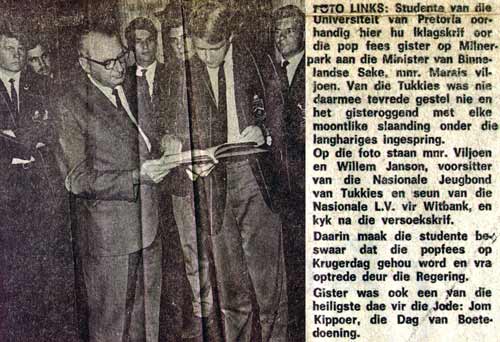
An Afrikaans newspaper article tells about the indignation Afrikaans students felt that the rock festival would be held on this important day.

Now, here another Mhambi secret. I know this modus operandi and the motive - this must have been students from Sonop, at the University of Pretoria. It's the residence Mhambi went to, and I too was as a first year, in 1990, a proud owner of a pick handle, which I named Corpus delicti (Latin: object that inflicts damage). For a while I was ready to defend the honour of Sonop against all and sundry. Still, for all my loyalty Mhambi was asked to leave Sonop, because I refused to cut his hair.

But back to Neil's story:

We pulled into the Fountains parking lot. There were a lot of people waiting there for the raiders to return. Ours was the first car back. The driver got out of the car to report to the ou manne. A crowd came over to the car. You ouens promised to look after me, hey! Don't worry! I was worried.

A guy called Herman opened the driver's door and leaned into the car. So you're one of the Communists! He slapped me in the face as hard as he could. I didn't feel it. I became aware of the fact that a part of me was observing this madness coldly and dispassionately...

Herman dragged me out of the car and delivered me to the waiting mob of children. My abductors, to their credit, they did try to intervene but to no avail... I was grabbed by my arms and legs and my backside was positioned to offer a tempting target. A guy started whipping me with an army belt. He worked really hard at it. I still felt no pain and even started laughing at the absurdity of the whole situation. This infuriated my abuser. Eventually, the blows became more and more feeble and petered out. Soutpiel, jy's 'n taai moerskont! (Englishman, your a tought cunt.) I presumed that this was meant as a compliment, coming from a divinity student and all.

By this time other cars with other victims had arrived. Haircutting was in progress. All of us longhairs, about eight in all, were pushed down to the ground in front of some cars that had their lights on. My hair was hacked off by a number of people brandishing scissors.


A festival - Pic: 3rd Ear Music

But the festival wen't on. As the 70's drew to a close the Hippies dissapeared but Hillbrow remained and increasingly became a space where all South Africans could escape the strictures of the Nationalist's rule. It and surrounding areas like Braamfontein and Yeoville became home to record labels, book shops, theatres, publishers, clubs, including gay-clubs.

While Hillbrow had a crass glamour neigbouring Yeoville was the home to a community of intelectuals, artists and discontents. It was here at BaPitas where you came if you wanted to buy your first acid, and it was here at places like Tandoor where you could play pool against very stoned but deadly accurate Rastas. It became the hub of a vibrant counter culture that defied all that apartheid stood for.

It was in Braamfontein that the Weekly Mail opened their offices and down the road was the Vrye Weekblad. The two weeklies were a powerful twin barrel searhlight exposing the activities of murderous security forces.

Venues like the Black sun provided a platform for political music. It was here that the brilliant mucician from the East rand James Phillips (aka Bernoldus Niemand) played. Soon Koos Kombuis and Johannes Kerkorrel came to share a flat in Hillbrow in the 80's, and like Leonard Cohen in New York, got laid in Hillbrow's own landmark but seedier Chelsea hotel.

It was here were they plotted the acent of their Voelvry movement - an up yours to the nationalists in their own language. Here in Hillbrow they held their first gigs, and where people like Ryk Hattingh (author and founder of Loslyf - the first Afrikaans porno mag) upon hearing music like Gee jou hart vir Hillbrow - wept "vat dit weg, vat dit weg." (Take it away - the Nationalists and all they represent that is).

Reshada Crouse, a friend of author Rian Malan decribes bohemain Yeoville in a recent article in the UK Observer:

Just down the road was the first block of flats in the whole of South Africa to have mixed couples. 'It was like New York in the Sixties,' Reshada says. 'Everyone was partying, great decadent fun.'

Yes, Hillbrow and Yeaville had its crime, but it was an utopia of sorts. Most significantly in the South African context, Hillbrow and it surrounds were multi-racial.

Democracy is sacrosant (3)

Sphere: Related Content

Monday, February 12, 2007

Democracy is sacrosant (1)

This whole business of Z Pallo warning potential De la Rey song traitors that it's wrong and bad news to organise against a democracy has set Mhambi thinking.

...and Mhambi came to this conclusion, I think Pallo is right, it's morally indefensible to organise against a democracy.


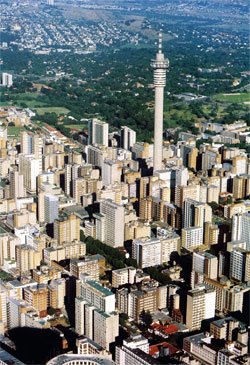
Hillbrow Skyscrapers basking in the Highveldt sun
Originally uploaded by nicky_joburg.


But this week Mhambi was watching telly, BBC 2's Newsnight nogal, and low and behold, up pops Hillbrow, Johannesburg. It was swartgallige reportage. Crime on the streets of Hillbrow is according to John Simpson, on bad days, as bad as anything he has encountered in Iraq.

To compound it all, the South African chief of police is a mafioso and the minister of Safety and Security says those that complain about crime "should immigrate". And the President? Well he is in denial again.

Most of you will know the story. You could be forgiven for thinking its a black comedy, but actually it's a very very sad tragedy, now with an growing international audience. Genugtig, Mhambi thought - South African crime has now gone prime time.

Then Mr. Simpson said something that I heard two other people say recently - something significant and it got Mhambi thinking again. Simpson commented that when he covered apartheid South Africa in the 1970's, Hillbrow was a place where white and black could mix. In spite of apartheid.

I remembered that once, in 1997, a pretty astute police detective told me - I think Fanie was his name - that during the 70's he was a narc and Hillbrow was his beat. Fanie got very animated about his experiences in Hillbrow.

I was a bit of a raver at that time, and like most ravers a sucker for stories of about a sub-culture that begat mine.

He told us how he and his colleagues had to stalk hippies that were tripping out of their skulls, on the roofs of Hillbrow's tall flats, while basking in the highveld sun. I could tell by the glint in his eye that Fanie liked that time.

When I spoked to Fanie, he was a frustrated detective in the investigation wing of the South African Truth and Reconciliation Commission. The reason, Fanie and hois team sat around allot of the time with very little direction and little to do.

Democracy is sacrosant (2)

Sphere: Related Content