One of the last remaining shoe factories in Cape Town.
Just the other day I was musing with friends why South Africa has not decided to peg its currency at a lower rate, so our manufacturing and services could blossom.
I have of late taken a keen interest in shoe manufacturing, as my girlfriend is a shoe maker. We have investigated manufacturing a range in Cape Town's dwindling shoe factories.
Besides the now growing skills and equipment shortage there is one startling fact that illustrates the South African problem. The average Indian factory worker gets paid about $24's per month. Compare that to a South African factory worker that gets $100 per month or higher.
In yesterday's business day Michael Power argues strongly for just the remedy we were talking about. Pegging the Rand low for the sake of being competitive.My essential view — which I have doggedly maintained for more than a decade — is that the rand remains structurally overvalued. The main reason I give is that the rand’s current trading range is trapped in the straitjacket of what works for SA’s first economy. But, at this elevated rate, the overvalued rand prevents the second economy from having even the remotest of chances of working, literally and metaphorically.
Let’s start with the basics. SA is living way beyond its means; we have a current account deficit of 7,8% of gross domestic product (GDP). To balance our national books, we need inflows of foreign capital of about R3bn a week, or R600m a working day. Those economists who say it is “natural for a successful developing country to run external deficits and so import capital” need to read pretty much any post-1980 book on real-world economics. Even at the risk of generalising, no, it is not natural to run a deficit if you want to be successful. The emerging economies that have grown most — essentially the east Asian Tigers and now the waking dragon that is China — have been the ones that have put export-led growth first by adopting a hyper-competitive currency; this puts current account surpluses at the centre of their development strategy.
I feel sorry for those economists who simply cannot accept that the “developing countries run deficits” piece of conventional economic wisdom is precisely wrong. Sure, occasionally when global liquidity is abundant you can run deficits and get away with it. But, to paraphrase Warren Buffett, when the tide goes out, then you see who has been swimming naked. And boy, did that tide go out! And sure enough, now everyone can see that SA dispensed with its (no doubt Chinese-made) swimming trunks years ago.
It is time to catch a wake-up, SA. Is this roller coaster we are riding going to be the way we continue to run our economy for ever and a day? Is our economic development plan to become little more than a case of surfing the ebb and flow of the credit cycle, while all the time being subject to the capricious kindness of strangers and their capital?
Will we ever remain little more than a slave to America’s unhealthy rhythms? Must we wait for the planets to align in our favour again, enjoy the party that follows, only to rue the hangover that follows thereafter? And worst of all, by far worst of all, are we in the first economy going to continue to avoid addressing the plight of those trapped in the second economy, unemployable in today’s global economy given today’s rand’s exchange rate? And do we practise this last denial by turning a blind eye to the economically disenfranchised, buying off our consciences with the equivalent of an annual 3% of GDP transfer by way of social grants for 12,7-million people? (If you answer “yes” to the latter, shame on you.)
So now it is my turn to play a game with you, dear reader. Think carefully before you answer this question. I offer you the following choice. Do we build SA’s economy by sticking with the “First Economy First” approach and go with a strong rand? Or do we do what east Asia did and adopt a “Second Economy First” approach, using a more competitive and so much weaker rand? You know which option I would go for.
Saturday, March 08, 2008
It's time to peg the Rand low like China

Friday, February 22, 2008
Was I wrong about the Zunami?
Mhambi has gone on record a number of times that Jacob Zuma might be a better president than Mbeki. He would struggle to do worse. He is more approachable, direct and that he would be a better candidate for the South African poor, because he is left leaning.
Well, is the new ANC more left? Or are we due for some more talking left walking right?
Two recent pieces of commentary and the actions of the ANC themselves have made me have serious doubts.
John Kane-Berman said earlier this week that several commentators argued that the real opposition to the government now comes from within the ruling party, not from opposition parties.
"There is a grain of truth in this, but it is mainly nonsense.
...on matters of policy, the Mbeki government seldom faced much opposition from either his parliamentary caucus or his party at large. Former education minister Kader Asmal last year spoke out against President Robert Mugabe. This belated lone voice aside, Mbeki’s policy of appeasement towards Mugabe has all along had his party’s support. Steal elections, ruin the economy, destroy the rule of law, squash human rights and ruin lives — none of this stopped the ANC, taking its cue from Mbeki, from cheering Mugabe when he jetted into town.
Nor was there much dissent on AIDS. Mbeki flirted with dissident theories and employed an equally misguided health minister, but nobody in the ANC spoke out while they thus trifled with people’s lives.
No dissent either when the government stifled the probe into the 1999 arms deal by the standing committee on public accounts (Scopa). Scopa started off its probe in a non-partisan manner. Then Mbeki and the deputy president, Jacob Zuma, weighed in with the help of ANC chief whip Tony Yengeni and the acquiescence of the speaker, Frene Ginwala. Mbeki was not prepared to permit an independent investigation.
Nobody in the ANC was willing to stand up for the right — and duty — of Parliament to hold the executive branch of the government to account for its expenditure of the public’s money. Since holding the executive to account is a parliamentary function prescribed by the constitution, this means that the majority party’s willingness to stand up for the constitution is open to doubt.
Nor is there much prospect that anyone in the ANC will object to plans to destroy the independence of the Scorpions or to undermine that of the judiciary.
These are all matters of principle, not party-political issues. But there has been little dissent on key areas of policy either. This includes the pervasive policy of racial preferencing. If black empowerment policies have been criticised, it has been on the grounds that they benefit an elite rather than the poor.
In Beards only sign of a move to the left Aubrey Matshiqi agreed:
This shift to the left is supported neither by the resolutions of the ANC’s December conference nor by the content of the budget speech, unless an increase in social spending should be seen as the victory of Marxist-Leninist-Hugo Chavezist thought over Hugo Boss-inspired policy orientations.
In my view, any shift in the short term that may occur in the ANC’s economic policy trajectory will most likely fall within the 1996 macroeconomic paradigm. This flows from my belief that the clash between newly elected ANC president Jacob Zuma and former party head Thabo Mbeki was more about a rift within the establishment and less about tensions between the establishment and an anti-establishment impulse.
Further more, the forces that united behind Zuma’s presidential ambitions should not be given some mythical leftist agenda — the support for Zuma by the Congress of South African Trade Unions (Cosatu) and the South African Communist Party (SACP) had no ideological basis.
Zuma is much closer to Mbeki in ideological terms than he is to Zwelinzima Vavi of Cosatu and Blade Nzimande of the SACP. This is why he went to the World Economic Forum in Davos and told investors there would be no change in economic policy.
Aubrey is also concerned about the increase in the budget surplus because of unspent Government money.
"What I know is that I am less excited about the budget surplus than I was before. It seems a large chunk of the surplus comes from money that the government departments fail to spend.
...This is the same Parliament that has very little influence in determining budget priorities. The problem is that the budget continues to be the tail that wags the policy dog."
But the problem is of course that the government do not have the staff and the skills to implement their budget allocations. This will be a subject of another post of mine. Sphere: Related Content
Monday, February 11, 2008
BBC Panorama reports on South Africa

...and it ain't good. View the South Africa Panorama report (video stream) here. Or read about it here.
Called No more Mandela's and made by long time Africa correspondent Fergal Keane, it is at times over dramatic and at times it contains faulty and shallow analysis, but its tone is right.
Hardly had Mhambi predicted that the ANC will suffer from left wing international attention two damning reports have come from the BBC.
Update
Fergal Keane did an interview on the BBC World Service about the documentary. Listen to that here.
Monday, February 04, 2008
The global left haunts the ANC
A week ago John Minto, the man responsible for organising vociferous protests in New Zealand against the Springbok rugby tours in the 80's, told the South African government: If you ever thought of giving me an award, not to bother.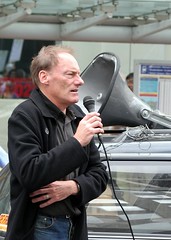
John Minto
Originally uploaded by farrioth.
We protested to fight apartheid and were proud of that and then Minto continued:
However while political rights have been won and celebrated, social and economic rights have been sidelined. It is now 14 years since the first African National Congress government was elected to power but for most the situation is no better, and frequently worse, than it was under white minority rule.
The number of South Africans living on less than $1 a day more than doubled to 2.4 million in the first 10 years of ANC government. Despite strong economic growth overall poverty levels have not improved and the gap between rich and poor has increased with many black families being driven more deeply into poverty. Unemployment remains high at around 26%.
At times I feel just a little sorry for Thabu Mbeki and the ANC. Why? Because of what John Minto said next:
"Apartheid was accurately described as a “crime against humanity” by the United Nations and the ANC. I could not in all conscience attend a ceremony to receive an award conferred by your office while a similar crime is in progress."

"Long batons fly in Newtown as riot police block protestors in Rintoul Street from reaching Athletic Park for the second test, 29th August 1981".
Apartheid was very very bad. But it has to be said, the Nationalists had some very stiff competition if one wanted to judge governance, exploitation and violence in this part of the world.
And quite frankly they never made it into the premier league of any of these categories. Want violence I'll name you tow dozens other countries that were worse. Governance? I'll name even more, exploitation? You kidding me? The governments of Uganda, Ethiopia, Rwanda, Sudan, the Congo, Algeria, Kenya, Nigeria, Zimbabwe, the Ivory Coast, Liberia, Angola to name but a few, were all at times much more bloody, corrupt and in greater neglect of the well being of their citizens, than apartheid South Africa.
In short apartheid does not deserve the moniker of a crime against humanity, in the context of what was going down routinely all across Africa, unless you want to concede the title to half the countries on the continent.
For various but very particular reasons (left wing moral relativism, simplistic analysis, historical Anglo antipathy towards Afrikaners) South Africa got the lion's share of the global left's opprobrium. Opprobrium that was completely out of proportion if one considers the suffering caused by an array of brutal regimes and the scant attention their actions received.
This 'exaggerated' attention morphed into uncritical support for the ANC. This helped the ANC enormously. It helped them set up office and organise. It helped them hide the Stalinist closed authoritarian nature of the organisation's external operations. It helped them cover their incompetence, and it helped them cover the torture and disappearance of their own members.
 A woman show signs of battle after protesters and red squad police clashed at the Luxford Street-Rintoul Street intersection during anti Springbok tour demonstrations in Wellington, 1981."
It helped obscure the fact that for many black ANC members the organisation was, not the creature of the Freedom charter, not liberal or progressive either. But a black Nationalist organisation at best, and for yet others it was just an instrument to attain power and resources.
But it helped the ANC secure negotiations and it helped them beat the Nationalists during negotiations.
But most importantly it also helped all South Africans, but particularly black ones get rid of the apartheid system. And less important, but also significant, it helped Afrikaners get rid of the Nationalists stifling and controlling morals and strictures.
After 1994 this global left's 'gaze' helped hold open debate in the country in a vice of silence, nobody dared criticize the ruling party. That was until the Aids deaths of thousands, creeping levels of inequality, blatant corruption and the intolerant battle for control of the ANC finally broke the spell.
But this progressive spot light has not gone away. As enamored as the Spanish speaking and American left of the world is with Venezuela, the English speaking world's lefties are fascinated by and have invested intellectually in South Africa. They are looking in a new way and they do not like what they see.
And as unfair as comparisons as the one above is in absolute terms (especially when compared to our neighbors) - they are still going to be made.
It's no help for Mbeki to point out that particularly since 2002 his government has with robust growth and an array of social grants - grants that very few developing countries have - managed to address poverty levels.
We are still measured with a different yard stick. The sword that helped struck down apartheid turns out was double edged. It will be wielded against the ANC. Their every move will be monitored like no other African government's actions will. But for South Africans by and large, like with the battle against apartheid, this is still a good thing.
John Minto again:
Receiving an award would inevitably associate myself and the movement here with ANC government policies. At one time this may have been a source of pride but it would now be a source of personal embarrassment which I am not prepared to endure.
Hear hear says Mhambi. Sphere: Related Content
Tuesday, November 13, 2007
The life and times of Adonis Musati
The BBC reports that Adonis Musati, the Zimbabwean that died in Cape Town foreshore, meters from the Department of Home affairs was a policeman. He had left Chimanimani Zimbabwe a month before, looking for work. He planned to send money back to his family.
Mhambi has been to Chimanimani. I hitch-hiked to there with a good friend Collin Minnaar way back. We were on the way to Zanzibar, via Malawi and Dar es Salaam Tanzania.
It was the end of 1994, just after South Africa's fully democratic elections. We - that is a bunch of Tukkies hippies - thought we should celebrate our reintegration into the African fold with an epic journey from Pretoria to the spice island.
 The hippies at Mandela's inauguration, May 1994 - Photo Jan Bezuidenhout
It was before Zimbabwe's marked decline. The people, although poor, were proud and healthy. There were little sign of political tension, but then again we were not looking for it. It felt much safer than back home. Two of my friends, Jan and Cecilia, even got a lift in a fancy car with a senior ZANU PF member.
Collin is very bad at getting up in the morning, which can be a problem when travelling. But he is very good at writing. In fact he is one of the most creative writers in Afrikaans. A joy to read, his emails never failed to surprise me.
As far as I know he does not write anymore. He immigrated a few years ago to New Zealand, and works, funny enough, in New Zealand's Home Office. His beat? Immigration.
Chimanimani is situated in Zimbabwe's eastern highlands. We got there on an open truck that krept up its hills. We spent a night in a tent, it was freezing. Chimanimani is small, it had little traffic and worse of all: It was a dead-end. We could not reach Mutare that way. We had to turn around and we were stuck for hours. But it was gorgeous.
Friday, November 02, 2007
Adonis Musati's death a blot on SA's name

Adonis Musati, a Zimbawean familiar with the Department of Home Affairs was found dead, presumably from hunger, meters away from the Departments office in Cape Town.
Bennett Hodi, the last to see Musati alive, said he came zigzagging across the road towards the Cape Town International Convention Centre on Friday morning and asked a construction worker for money to buy a loaf of bread.
Hodi, a guard at a nearby construction site, said although none of the workers had money, a colleague decided to buy the bread as they could see Musati was hungry and weak.
"He told us he hadn't eaten in two weeks," said Hodi. "We gave him the bread and he finished half a loaf in seconds.
"He then asked for water and swallowed a few sips before lying down under a tree on the island opposite the Convention Centre.
"A few minutes later we noticed he was lying on his back with his legs and arms stretched out. That's when we rushed over and saw he wasn't breathing. We immediately called the police."
Braam Hanekom, chairperson of People Against Suffering, Suppression, Oppression and Poverty (Passop), was greeted by a crowd of people standing around Musati's body after being released from the holding cells at Cape Town Central police station on Friday afternoon.
Braam Hanekom was arrested the previous day when asylum seekers fought the South African police.
...a group of about 40 refugees had refused to leave the department's premises after waiting for more than seven hours to be served.
One irate Zimbabwean refugee said he had arrived at the department at 2am, hoping to be one of the 100 firstcomers that the department recently agreed to serve.
"After waiting for seven hours, they told me I needed to fill in a form with my details and they would phone me on Wednesday to be helped. I can't wait until Wednesday because I may be picked up by police who will arrest me and deport me," the emotional man said.
Despite being informed that they might be arrested for trespassing, the angry group staged a sit-in at the offices, refusing to leave until they were served.
Helpless officials then called the police who explained to the group that they could not sleep in the centre because the department was not liable for their safety.
After 30 minutes of negotiating, the police called for back-up.
A Cape Argus team witnessed a group of about 15 police officers disperse the group using pepper spray.
A Zimbabwean refugee, who reiterated that he could not leave because he would miss his turn in the queue this morning, curled into a ball and started crying.
Attempts at asking him to leave failed and about seven policemen started kicking him.
Passop chairperson Braam Hanekom then pleaded with the police to stop and requested that they remove the man without force.
Upon exiting the building, police taunted the crowd by laughing at the injured Zimbabwean and a scuffle ensued between Hanekom, another Passop member and the police.
Police again sprayed the crowd with pepper spray and chased the group from the premises, warning that they would be beaten with batons and arrested.
Hanekom and a Passop member known only as Ben were handcuffed and shoved into a police van. The two are to face charges of riotous behaviour.
Braam Hanekom said to the BBC: "It is a disgrace that someone should die of hunger in one of South Africa's richest cities" Sphere: Related Content
Thursday, March 15, 2007
Left rhetoric right wing actions
James challenged me the other day because of something I said in my post "De la Rey is a left wing icon": "It is a somewhat astounding fact that the Nats during their rule, consistently decreased economic inequality amongst and between all South Africans".
What did you base that on? Not to be argumentative, but if inequality was decreasing in a noticeable way between black and white under apartheid, then why was there any disatisfaction with it? If you have some kind of source that you drew that statement from, I'd really like to read it....
And too right. It is a contentious statement and deserves to be backed up with fact. Especially since the ANC has come to power South Africa has endured its longest peroid of continued economic growth in history. All south Africans should be richer.
All South Africans should be richer
The Nat's record was not consistent in the beginning but they did reduce poverty AND inequality, especially under Vorster and PW Botha.
"Despite the steady improvement in the wages of workers since the 1960's, the racial disparities were such that South Africa was near the top of the inequality league in the world."
(South Africa now tops this league.)
"From the early 1970's the government and employers initiated a steady process of redistribution away from whites that changed the position considerably. A significant redistribution of income was the result...
By 1994, blacks contributed R23 billion to government revenue, and received R34 billion in cash and in-kind transfers from government of which the largest part went on social welfare, housing, health and education."
"Whites still received nearly half of the amount the state spent on public services, but they received much less in services than the amount of tax they paid, while blacks were receiving considereably more.
Spending on social welfare for colored and Asians rose at an even more rapid rate than on blacks, and accelerated after 1984 when the government embarked on systematically reducing the disparities that still existed between the three groups that participated in the Tricameral parlaiment."
The social spending contributed to a severe fiscal crises that the state experienced from the mid 70's, other contributing factors being the War in Namibia and Angola, and the expansion of the civil service.
"A severe tax burden now weighed heavily on middle-class whites... according to an IMF study, whites by 1987 paid on average 32 percent of their incomes in tax, but received only 9 percent back in benefits."
These qoutes are from Stellenbosch academic Hermann Giliomee's book. The Afrikaners - Biography of a People.
He notes that the government started to encounter serious resistance from certain whites because of these progressive taxation policies.
He concludes his book with the end of the Nat's rule. He states that during 1948 to 1994 - the period of their rule - the economy grew four and a half times, and that the life expectancy of all South Africans increased. He notes however that the phycological damage of apartheid was heavy. The book has allot more information, numbers and references if your interested.
Contrast that to the dramatic drop in South African life expectancy since 1995.
The World Socialist website analyses the UN Development report on South Africa for 2004:
It acknowledges that there have been some positive aspects, like the building of many houses, but cats aspersions on the quality of these house since the housing subsidy dropped. It continues:
"Between 1995 and 2002, life expectancy at birth is estimated to have declined from 61.4 years to 51.4 years, indicating a 16.3 percent drop. This is largely due to the massive impact of Aids.
The statistical average hides a worse reality. In 2001 the life expectancy of blacks was 51, contrasted to whites with a life expectancy of 69. In 2001 more than 28 percent of blacks in the 30 to 39 age group were estimated to be HIV positive.
This is compounded by the drop in the total number of health professionals, which, according to the South African Health Review, declined between 2000 and 2002. According to the UNDP report: “In many hospitals and clinics around the country, there are insufficient medical and support staff to handle the workload. There are simply not enough funds being allocated to the hiring of additional staff and the payment of more attractive salaries.” The inequitable distribution of health services is also evident...
The level of inequality is confirmed by the Gini coefficient. A Gini coefficient of one indicates perfect income inequality, while a Gini coefficient of 0 indicates perfect equality. The report notes that in 1995 the Gini coefficient for South Africa was 0.596, rising to 0.635 in 2002. The report goes on to note: “In view of this rising income inequality, only six percent of all people who reached retirement age of 65 in 2000 can be regarded as financially independent. About 47 percent of people retiring are dependent on their families, 31 percent have to continue working and 16 percent rely solely on a pension from government...
The UNDP report states: “Steep wealth inequality ... contributes to persistent and rising income poverty and inequality.” This is in a context where the ruling class has “enormous corporate power and a direct influence over the economic lives of the majority of South Africans.” The government’s pro-business policies have undoubtedly added weight to already powerful corporate influences...
Ernst and Young Management Services reported that in 2003 R42.2 billion ($US620 million) worth of BEE deals were made. But the beneficiaries of these deals belonged largely to the politically well-connected elite.
The opposition Democratic Alliance noted that 60 percent (R25.3 billion) of these deals “accrued to the companies of two men [both close to the ANC leadership]: Patrick Motsepe and Tokyo Sexwale”."
One of the most worrying aspects is that school enrollment has also dropped, and while some claim the average South African is not getting a better edication, this is contested by some Wits academics I spoke to. Mhambi can stomach allot, provided he knows that South Africans are getting a propper education. But if we are not bettering the youths education, then our tomorrow will probably be worse.
Symbolic and material happiness
You ask that if the Nats decreased inequality, why were black South Africans unhappy? I spoke only of economic inequality. I don't know how old you are, but if you were old enough to have rememered the apartheid days, you would hopefully realise how dehumanising it was. It made you feel as if you don't belong, that your a second class citizen.
Essentially black South Africans were unhappy for the same reasons asAfrikaners today, who are by and large doing well economically, but very unhappy.
Don't believe the World Socialists? You can read the 2006 UN Human development report for yourself, where south Africa did significantly worse.
And chew on this chart of South Africa's Human Development Index vis-a-vis other territories from the UN's 2006 report.

But if you drove around South Africa today you knew this already. Quite frankly the poverty and conspicious consumption you see everywhere is obsene. Sphere: Related Content
Saturday, January 20, 2007
How many $100 laptops could Oprah Winfrey buy South Africa?
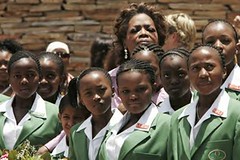
You may know Oprah Winfrey has opened a $40 million school for girls, south of Johannesburg. Apparently this is a greater sum than the US government spent on development in the whole of Africa last year.
Mhambi says many thanks Tannie Oprah. But Mhambi would wonders how many of Nicolas Negroponte's $100 laptops she could have bought with $40 million and if it would not have been money better spent?
A quick bit of maths brings me to believe that Oprah's money could have bought 400,000 laptops. Which is quite allot. Who would she give it to? I would suggest the poorest children in Gauteng.
The South African government has divided all school pupils into 5 categories according to how poor they are. In Gauteng, the smallest but most developed province there are 383,674 pupils in the poorest and largest category. This province would be ideal, relatively densely populated and with good roads, the wireless mesh technology built into the laptops could cast a wireless blanket.
Oprah could have given all of these poorest pupils $100 laptops, and probably could have covered of the next poorest category with what she will need to maintain the school and pay its staff. Just imagine 400,000 plus laptops creating their own wireless mesh all over the province and giving access to the poor to the Internet.
Mhambi is no pedagogue but he reckons that if you give children the opportunity they will learn to use these instruments themselves, without too much hassle, as if by magic. (Many South African teachers have no clue how to use a computer). Imagine the creativity it could unleash?
Now if only the South African government could deal with the predatory monopoly that is Telcom and bring down internet access costs.
And if Joe Modise's estate could repay the £500,000 and $10 million bribes for British Hawks and German subs, we would be looking at another 110,000 plus laptops, and if Shaik and Zuma... Sphere: Related Content
Wednesday, January 03, 2007
Can Californian capitalist hippies save the developing world
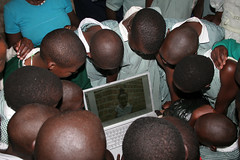
There was a time when a UK academic, Dr. Richard Barbrook, accused the digirati of California of believing in a misleading ideology, the "Californian Ideology".
According to him Net heavy-weights like Kevin Kelly, Esther Dyson and Steve Jobs were beholden to this Californian ideology. A weird hybrid ideology that married ideas associated with the right, free market economics, and those that came from the left, counter-culture libertarianism.
Barbrook said:
"On the West Coast, skilled workers and entrepreneurs in the hypermedia industries form the 'virtual class'. Like the 'labour aristocracy' of the last century, core personnel in the media, computing and telecoms experience both the insecurities and rewards of the marketplace. The Californian Ideology reflects this ambiguity by simultaneously advocating the New Left utopia of the electronic agora and the New Right's vision of the electronic marketplace.
However both left- and right-wing anarchists ignore the key role of taxpayers' dollars in the creation of the PC and the Net. The exclusion of public institutions from the construction of cyberspace can only increase the fragmentation of American society into antagonistic, racially-determined classes."
But today one of the cyber gurus that Barbrook accuses, Nicolas Negroponte, made an announcement that both disproves and supports Barkrook's contention.
Negroponte, head of the Massachusets Institute of Technology's (MIT) Media Lab announced the wonderful news that the first batch of computers built for the One Laptop Per Child project could reach users by July this year.
The One Laptop Per Child Project aims to deliver the children's laptop — a potent learning tool created expressly for the world's poorest children living in its most remote environments.
The laptops will run a bespoke form of Unix operating system where they are encouraged to work on an electronic journal, a log of everything the user has done on the laptop. Because says Negroponte:
"...one of the saddest but most common conditions in elementary school computer labs (when they exist in the developing world), is the children are being trained to use Word, Excel and PowerPoint," Mr Negroponte said.
"I consider that criminal, because children should be making things, communicating, exploring, sharing, not running office automation tools."
The proposed $100 machine will also have a dual-mode display—both a full-color, transmissive DVD mode, and a second display option that is black and white reflective and sunlight-readable at 3× the resolution.
The laptop will have a 500MHz processor and 128MB of DRAM, with 500MB of Flash memory; it will not have a hard disk, but it will have four USB ports. The laptops will have wireless broadband that, among other things, allows them to work as a peer-to-peer mesh network; each laptop will be able to talk to its nearest neighbors, creating an ad hoc, local area network. The laptops will use innovative power (including wind-up) and will be able to do most everything except store huge amounts of data.
Why do children in developing nations need laptops? Why not a desktop computer, or—even better—a recycled desktop machine? Negroponte answers:
Desktops are cheaper, but mobility is important, especially with regard to taking the computer home at night. Kids in the developing world need the newest technology, especially really rugged hardware and innovative software. Recent work with schools in Maine has shown the huge value of using a laptop across all of one's studies, as well as for play. Bringing the laptop home engages the family. In one Cambodian village where we have been working, there is no electricity, thus the laptop is, among other things, the brightest light source in the home.
Why is it important for each child to have a computer? What's wrong with community-access centers?
One does not think of community pencils—kids have their own. They are tools to think with, sufficiently inexpensive to be used for work and play, drawing, writing, and mathematics. A computer can be the same, but far more powerful. Furthermore, there are many reasons it is important for a child to own something—like a football, doll, or book—not the least of which being that these belongings will be well-maintained through love and care.
What about connectivity? Aren't telecommunications services expensive in the developing world?
When these machines pop out of the box, they will make a mesh network of their own, peer-to-peer. This is something initially developed at MIT and the Media Lab. We are also exploring ways to connect them to the backbone of the Internet at very low cost....We are working with the local governments and the private sector regarding how to reduce the cost of Internet access.
This includes connectivity to the Internet from the mesh through gateways at the schools. And how will these be marketed?
The laptops will be sold to governments and issued to children by schools on a basis of one laptop per child. Initial discussions have been held with China, India, Brazil, Argentina, Egypt, Nigeria, and Thailand. An additional, modest allocation of machines will be used to seed developer communities in a number of other countries. A commercial version of the machine will be explored in parallel.
How will this initiative be structured?
The $100 laptop is being developed by One Laptop per Child (OLPC), a Delaware-based, non-profit organization created by faculty members from the MIT Media Lab to design, manufacture, and distribute laptops that are sufficiently inexpensive to provide every child in the world access to knowledge and modern forms of education. OLPC is based on constructionist theories of learning pioneered by Seymour Papert and later Alan Kay, as well as the principles expressed in Nicholas Negroponte's book Being Digital. The founding corporate members are Advanced Micro Devices (AMD), Brightstar, Google, Marvell, News Corporation, Nortel, and Red Hat.
...
To keep the cost down we will market the laptops in very large numbers (millions), directly to ministries of education, which can distribute them like textbooks.
So there you have it. Barbrook was right. Negroponte can not deviler his digital utopia and save the world without the help of not-for-profits, academia and government. But he was wrong because Negroponte is well on his way to actually have an almost unimaginably positive impact on the lives of poor people in the poor parts of the world. Sphere: Related Content
Tuesday, December 12, 2006
SA grows - to grow faster we need more skills more roads
The Business Day reports that the South African economy is in record breaking territory. One worry is the high debt house hold ratios, and the low levels of saving. And to sustain and even better it, the country needs better infrastructure and skills - that it does not have now.
THIS year, SA’s economy made history, reaching record highs and long-time lows measured by a range of rates and ratios.
The “making history” idea was the starting point in a paper on SA’s economy by Harvard economist Jeffrey Frankel and colleagues at Stellenbosch University. They commented that by early this year, economic growth, consumer spending, household debt, the gold price and the current account deficit were at levels not seen since the early 1980s, while inflation and interest rates were at lows not seen in more than three decades.
Since they presented their paper, a few more records have been broken. The budget surplus (now expected next year) would be the first on record (though the records go back only to 1960); household debt has risen even higher; interest rates and inflation are no longer at the lows seen in the first half of this year; but SA’s equity and bond markets have seen an unprecedented R102bn of foreign investment so far this year. Household debt is at a historic high and national savings at a historic low. But investment spending has risen to 18,7% of gross domestic product — the kind of level last seen in 1990. We’re still some way off the 25% that government has targeted as the level needed for SA to sustain growth of 6% or more, but it’s headed in that direction. And raising the rate of investment, public and private, is core to the Accelerated and Shared Growth Initiative (Asgi-SA).
...
But is it too late? The question is raised by Nedbank economist Dennis Dykes in the bank’s latest Guide to the Economy. There is evidence, he argues, that the investment drive has come too late and economic growth is likely to be constrained in the short to medium term. Dykes points to the lack of efficient transport and energy infrastructure and capacity. That is being addressed, but will take time.
But the problem is not only public infrastructure; Dykes notes the private sector also lacks effective productive capacity, hence the shortages. Net domestic investment (after depreciation) has been below 6% of gross domestic product (GDP) for over two decades; under the circumstances, it’s surprising the economy has grown as well as it has.
Read more.
Thursday, December 07, 2006
Buying fruit locally makes for an unfair world
Transporting (yes even flying) food to Europe from Africa is not bad for environment. Mhambi was at a talk organised by the Pesticide Action Network (PAN) at the RSA in London about how Western consumers could help African cotton farmers.

In reaction to the persistent argument from organic campaigners to buy food locally their was a emphatic retort. Dr. Camilla Toulmin, Director of the International Institute for Environment and Development (iied) said that transporting fruit, vegetables and other agricultural products from African countries to the UK, including by air, contributes less than 0.1% of the current carbon footprint of the UK. This is even true of perishable products like fruit, and even more so for products like cotton, which can be shipped by sea which emits even less carbon than air cargo.

Considering the fact that more than 1 million of the world's poorest farmers depend on this trade, the point was made very forcefully that by targeting this 0.1% carbon footprint, organic and environmental campaigners were completely misdirecting their activism with very unfair results for developing societies.
Buying locally produced food is often used by organic, environmental and the European subsidy lobby, to argue against the lifting of subsidies to European farmers. Sphere: Related Content
Friday, November 24, 2006
Can columbia teach SA on crime?
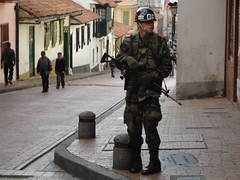
Rio de Janeiro's newly elected governor, Sergio Cabral, recently announced plans to use Colombian security techniques in an attempt to pull the Brazilian city out of a cycle of violence that claims about 6,000 lives each year. According to a recent study of violence based on World Health Organisation figures, a total of 55,000 Brazilians were murdered in 2005.
Officials in Medellín, Cali and the capital, Bogotá, have presided over plummeting crime figures since the early 1990s. The initiatives included community policing schemes and increased investment in the police force, as well as educational projects which saw former gang members giving speeches in primary schools, additional street lighting and the modernisation of shantytowns.
In 1993 Bogotá was the scene of 4,352 homicides, or 80 killings per 100,000 inhabitants. This year the figure is 18 per 100,000 - a 75% drop and less than half that of Rio de Janeiro, which has a murder rate of about 42 per 100,000 inhabitants. There were 858 homicides in 2005-06 in England, Scotland and Wales.
Mhambi knows that there were some 18,793 homocides in 2005 in South Africa, of which 3,600 were in the province of Gauteng, which is really just Johannesburg and Pretoria. The ratio is 40.8 per 100,000 inhabitants for Gauteng. And 40.3 for the country as a whole. Very similar to the current level for Rio.
During a visit to Rio, Mr Velásquez - one of the Colombian security experts behind the anti-crime initiative - emphasised the need to mix social services with brute force. "It wasn't just police and the law," he told the O Dia newspaper. "[We asked ourselves] how many schools are there in this place? How many children studying? How many health clinics? Does the lighting work in this neighbourhood? Is there rubbish collection? Or rather, we went in with all of the institutions to make improvements."
Sphere: Related Content