In today's Business day Prof Anthony Butler of UCT's Public policy department sets forth that simultaneous events have conspired to seriously dent confidence in South Africa, both internally and externally. These dents were possible in the context of widespread perceptions of crime, corruption and problems in the health service.
Apparently the Financial Times have talked of a “loss of faith” and the Wall Street Journal has been lamenting a “Dark South Africa”.
He sees the emigration accelerating and investment falling, and that this will feed a vicious circle that will make skills even dearer and harder to find, this in turn will exacerbate the problems of corruption, service delivery, crime, public health and especially Aids.
He also warns of white fears becoming irrational bleak.Such multifaceted uncertainty about the future can open the door to a more profound, irrational terror. Some whites, in particular, when they reflect on their deepest fears, discover a submerged expectation that poverty and pent-up frustration must eventually result in a vast social explosion.
Others fuel their fears with a vague and unarticulated sense that the postcolonial African state must always fail. In minds where such doubts lurk, there is always fertile ground for apocalyptic visions to grow. Practical challenges become interlinked in a vicious cycle of crime, skills loss, moral breakdown, AIDS, political instability, panic, and emigration.
Monday, February 18, 2008
Afro-pessimism is spiralling out of control

Sunday, February 03, 2008
Goeie genugtig - The end is nigh?!
Adding insult on top of injury. The Mail & Guardian reports that an ANC front company, Chancelor house, has a huge stake in the build of new power stations that is now planned.
Chancellor House’s 25% stake in Hitachi Power Africa, which will perform 60% of the contract, translates to about R2,8-billion of the R18,5-billion total value. Coming on top of its R3-billion stake in the Medupi contract, this almost doubles the ANC company’s known stake in Eskom’s capacity expansion programme to about R5,8-billion. How much of this will be profit is not known.
In another report it was claimed that some mines are already planing job cuts as a result of the power loss induced closures.
And just to make sure we spread the doom with the gloom, a Finweek report claims an educational crisis is at hand. And it's getting worse, not better.
For the past 16 years, fewer than 7% of Senior Certificate candidates passed higher-grade maths, according to a 2007 Centre for Development Enterprises survey on maths and science in schools. But in 2006, only 4,8% passed higher-grade maths, and only 5,7% passed higher-grade science, Finweek's report says.
The prognosis for the matric classes of 2010 and 2011 is not much better.
When the class of 2010 (now in grade 10) was in grade three in 2001, the national survey of performance showed that 30% did not achieve the required standard in numeracy, and 54% did not achieve the required standard in literacy.
For the class of 2011, the 2005 grade-six evaluation showed that only 28% performed at the required standard in numeracy. For literacy, it was only 38%.
In addition to the education crisis, South Africa is losing skilled professionals to other countries that use South Africa as a hunting ground for recruitment, says Finweek. A study recently found that the loss of one skilled professional in South Africa costs up to 10 unskilled jobs.
Then theres a report of a water contamination crisis. According the Mail & Guardian the report is the latest of several recent indicators that the government is no longer able to monitor effectively and manage its vast infrastructure of dams, pipes, pumps and treatment facilities.
Adding to the stink is this report of sewerage flowing into Durban harbour.
And in another Mail & Guardian report, refugees arrested inside the Johannesburg Methodist Church, have claimed that they have been mistreated, denied medical treatment and bribed by police.
Never mind all this says Xolela Mangcu. The intolerance the ANC is now showing to the Mbeki backers within the party is the real bell weather of the problems our country if facing. Sphere: Related Content
Thursday, January 31, 2008
Where's the power to the people?
Mhambi has just returned from an exhilarating 2 month visit to South Africa. Friends of Mhambi might smirk at that. Exhilarating perhaps if your a student of social trends they might say. Scary or downright depressing if you happen to live in South Africa.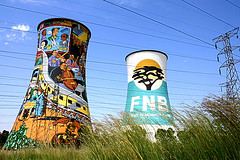
Derelict cooling towers
Originally uploaded by Leorex.
And it has to be said, very few of the whities - including old lefties - I met were not envious of me living overseas. And a few of the black South Africans and other blacks I met expressed similar concerns. The only optimistic whitey I heard of was my one nephew. He's a successful businessman.
At a dinner party with committed and very informed lefties I was left in no doubt. It was good that I left when I did they said. There was the Zuma, Mbeki battle, the Selebi shenanigans. But the power black outs were the straw that broke the brave optimistic camel's back, they said.
"It's symptomatic of the retreat of the state." The once mighty South African state is in free fall. South Africa now has more than 3 times the number of private security officers than police. The state gave up any pretense of ensuring its citizens physical safety. And now its the power. "Now people will start to supply their own power". Their is no confidence in public policy and the state. "It's every one for themselves".
This is the type of world where the rich will flourish and the poor will suffer. Not a comfortable world for those of us with a social conscience.
It should not be lost on anybody that it was first recommended to this government that it needs to invest in power generation circa 1998. That is a few months before the government embarked on a multi-million Rand arms deal, that turned out to be highly corrupt. 
Even if not corrupt the wisdom of this deal was questionable in some respects. South Africa faces little by way of a conventional military threat. But the corruption involved catapulted the costs while introducing more hardware of dubious use to the Republic. What is clear now is that energy generation was not on the agenda.
Compounding the depression has been the response of the government AND the opposition. Government has claimed that we are suffering because of a growing economy and greater demand and that other countries, the US, Canada and Brazil has suffered similar issues. Meanwhile the opposition, besides rightly labeling the government as inept, pinned for privatisation.
Government claims to have planned and directed this kind of economic growth so surely this can not be an excuse? Besides, a 1998 white paper acknowledged the need. And as the Mail and Guardian pointed out, current power usage is actually below peaks of a year before, but none of the existing power stations are running at full capacity anyhow, probably because of a lack of staff shortages.
As for the US, Canada and Brazil argument. Yes, they have had black outs. Mhambi has little knowledge about what transpired in the Brazilian case, but in the others I do.
In the US and Canada the problem was caused in 2003 by a lack of spare capacity on a particularly hot day, coinciding with an accident. The power was restored everywhere within two days. This can not be compared to a decade of neglect in South Africa.
California however did have a more protracted crisis. It coincided with being the first energy market in the world to be deregulated. According to Wikipedia:
State lawmakers expected the price of electricity to decrease due to the resulting competition from deregulation; hence they capped the price of electricity at the pre-deregulation level. Since they also saw it as imperative that the supply of electricity remain uninterrupted, utility companies were required by law to buy electricity from spot markets at uncapped prices when faced with imminent power shortages.
When the electricity demand in California rose, utilities had no financial incentive to expand production, as long term price were capped. Instead, wholesalers such as Enron manipulated the market to force utility companies into daily spot markets for short term gain. For example, in a market technique known as megawatt laundering, wholesalers bought up electricity in California at below cap price to sell out of state, creating shortages. In some instances, wholesalers scheduled power transmission to create congestion and drive up prices.
The energy crisis was characterized by a combination of extremely high prices and Rolling blackouts that lasted for 12 months from 2000 to 2001.
Here, it is predicted that our problems will last for at least 8 years. Privatisation will not necessarily solve South Africa's problems as should be clear from the above example. It will most certainly lead to more expensive energy. It will be bad news for the poor.
People seem to forget that the Nationalists' nationalised Eskom provided South Africa with the cheapest energy in the world. They forget that a nationalised Telkom provided us with cheap phone calls, and that the privatised version is the most expensive internet service provider in the world.
As with the police, you can expect the ANC not to object to the creeping privatisation of power. As was pointed out in fascinating book The criminilisation of the state in Africa, privatisation in Africa often leads to more opportunities for corruption.
No wonder my friends are so depressed. Round here you are on your own and only the very rich and ruthless are still smiling.