Richard Barbrook, has published another book, called Imaginary Future's. Essentially it's an argument against technological determinism. An argument against the belief that superior technology is going to make the world a better place. It's still up us to decide how to use technology best he says. It's for us to shape the technology.
Richard wrote a great polemic a few year's ago in which he claimed that most New Media/ Internet fundies, techies and entrepreneurs are beholden to an ideology, which is a hybrid belief system that mixes left inspired libertarian philosophies like feminism and civil rights, and right wing market capitalism. He called this the Californian Ideology.
In the video Barbrook explains a bit about his book, which he says is "a history of the future".
Thursday, February 14, 2008
Don't imagine, just do it

Thursday, October 25, 2007
Telkom doth protest too much
Mhambi read Telkom's response to Icasa's threat to forcing a cut in the wholesale fees that other operators paid to use its bandwidth with some interest. Telkom fielded Deloitte consultant Chris Williams:
"Forcing wholesale prices down would remove any desire by Telkom to invest in more infrastructure, he said.
An unexpected side effect of Icasa’s “remedy” would be to discourage other operators from building their own networks, further stifling the industry’s development, said Telkom’s specialist for regulatory and technical strategy, Richard Majoor.
Operators would compete by offering rival services over the same infrastructure only if that was cheaper than building their own. This would restrict the choices open to consumers."
Good point Chris, which is exactly why we need this regulation. Look at what happened in other countries. Having duplicate networks especially in the so called 'last mile' (the bit that goes to clusters of homes) is economically wasteful and prohibitively expensive to build.
Competition is only realisticly possible in long distance lines, as there are fewer of them used by thousands of people.
Personally Mhambi thinks regulation of the last mile is very difficult, and I have serious doubts about Icasa's ability to do so. Thats why Telkom should be nationalised like I explained here.
Telkom, please stop holding the country back.
Tuesday, June 26, 2007
Mhambi's qoutables
Yahoo!'s founder, Jerry Yang on retaking control of the management of the troubled company sounded more like an Insead graduate than a switched on Dotcom entrepeneur:
"My immediate and overarching priorities are to realise Yahoo!'s strategic vision by accelerating execution, further strengthening our leadership team and fostering an even stronger culture of winning."
Err... sell your Yahoo! shares fast.
Facebook v MySpace - a class divide | The Guardian
The UK Guardian reports that in the US Facebook v MySpace - a class divide | The Guardian | Guardian Unlimited: "Social networking websites MySpace and Facebook are increasingly splitting along class lines, according to a US academic."
Facebook users "tend to come from families who emphasise education and going to college. They are primarily white, but not exclusively". MySpace, meanwhile, "is still home for Latino and Hispanic teens, immigrant teens" as well as "other kids who didn't play into the dominant high school popularity paradigm".
Saturday, June 16, 2007
Virtual brands will soon be 'real'

Red Heels @ Strata
Originally uploaded by m|a|r|q|u|e|z.
Second life, the best know online 'world' allows its users to design and build houses and almost anything else besides, including clothes and shoes. And because all users keep copyright, and because its easy to copy items in a digital world, a brisk trade in digital items are taking place.
Apparently this also makes second life 'manufacturing' and retailing into a low margin high volume business. Unless of course one can establish a brand. Some established brands like Puma are already retailing trainers in Second Life.
But Mhambi reckons its only a matter of time that a brand which originates in Second Life goes 'real' and finds it's was into a shop near you.
Monday, June 11, 2007
Facebook - the social operating system

Has it ever happend to you that someone has told you about something, and the next day another tells you about it, and then another.
Mhambi was told about Facebook last week. And again. And then I got an invitation to join.
So Mhambi joined Facebook last week. Now Mhambi has a MySpace, Flickr, Digg, YouTube, Muti, Blik account, but never have I found signing up and finding friends so easy. As you use it, its simplistic power wonders and charms. It's the social networking site of social networking sites. A meta web 2.0 site.
And then today on the Tube I read Jeff Jarvis' always excellent Media Guardian column. It was about, you guessed it - Facebook.
What is Facebook's secret sauce? I think it starts with identity. On the otherwise anonymous and pseudonymous internet, this is a place where real identity matters: I use my name and I associate with people whom I actually know. Soon after I started, I got invitations from strangers and asked my blog readers about the etiquette of responding. I was told that, in school, one accepts all invitations, because you are all in the same institution and it's rather like an arms race; school is, after all, a popularity contest. But we newcomer adults already seem to be developing a rule (borrowed from the similar business site LinkedIn) that we should befriend only those we know; it is an endorsement. So we are the masters of of our identities and our communities, which establishes trust. I think internet users have been yearning for such control.
What struck Mhambi is that one of ots peculiar successes is how Facebook somehow gets you to send messages to friends that are in your email address book anyway. And that you never message. Why? Perhaps because it's a more social, easier, friendlier environment than an email interface.
Facebook has two other incredible features which Jarvis explains:
Next, Facebook introduced what it calls a newsfeed, filled with simple updates about what your friends have done on the service: one posted a photo, another a video, two more befriended the same person, four others started using a feature.
...it is not news as we know it, but it has news value: if four friends I respect start using a program, that's good enough reason for me to look at it. As one blogger said, this isn't the wisdom of crowds but the wisdom of my crowd. It is like the talk around the cracker barrel in a frontier general store: the protonews of my small society.
But Facebook is also becoming a programming platform.
That is, it enables anyone to create applications on top of the service. Already there are scores of aps hooking up users' information with other services such as calendars, maps, chat, music, news, shopping, and much more. Every media, entertainment and web company needs to figure out how Facebook can help their communities. It is not just about widgetising content - the latest web 2.0 fad - but about people doing things together.
Zuckerberg's ambition for Facebook -which he has so far refused to sell, even though it is said he has been offered more than $1bn - is nothing less than for it to become the social operating system of the web, the Google of people.
MySpace eat your heart out. Sphere: Related Content
Sunday, April 29, 2007
Telkom should be nationalised now
A free market in telecoms is near impossible. But many young tech enthusiasts are blissfully ignorant to this fact. South Africa is no different. Often one hears the mantra, by the ZA-digirati: If only there was proper competition in South Africa, then the outrageous internet and telecoms costs would come down.
Telkom Hellkom Djouma
Originally uploaded by Deon Louw Botha. How does this idea explain this story then?
Mhambi read via Wired Gecko about report on Engadget that the Indian Government aims to supply each citizen with a 2Mbps internet connection by 2009. Wow, amazing.
"...now the real hotness is in connecting up an entire nation. According to IndiaTimes, the government is proposing that all citizens of India receive complimentary 2Mbps internet by 2009, and the service would be provided by the state-owned BSNL and MTNL. Officials backing the plan are hoping that giving all residents access to high-speed internet would "boost economic activity""
The government intervening to supply cheap telecoms dumbfounds most of the tech ideologues. Even when it worked before in places like South Korea.
Ideologues?
Yip, you heard me. In the West the prevailing orthodoxy is such - there must be competition in telecoms provision, because the free market must prevail, service will spread and it will drive down prices. A British academic, Richard Barbrook, hit the nail on head when he coined this pervasive ideology the Californian ideology. It's worth a read.
A brief look at the history of telecoms should indicate that things are not that simple. Telecoms tend to be natural monopolies. The economic value of the network rises exponentially with the connections or users added, and considering the costs of constructing the network, especially the last mile, it's economically inefficient to have two separate networks. If left alone the larger network will swallow the smaller.
In practise Western governments accepted this fact. The USA realised that for the US to get a large network they should allow AT&T to develop unhindered, but to regulate the prices and the the roll-out to sub economic parts of the country (called universal service). Although nominally a private company Ma Bel (AT&T) under these conditions grew fast and provided all Americans with cheap phone calls. The government regulated its prices but the economy of scale it achieved made it still possible for AT&T to be hugely profitable.
In the 80's with the rise of Thatcherism and Ronald Reagan, right wing ideologues launched an assault on this old idea of a public telephone monopoly under government control. Competition was forced into all markets and also this market. But this particular one was no free market. To create competition a web of legislation, regulation and monitoring had to be spun, else the incumbents would just swallow up the new comers.
After more than a decade of a dearth of true competition, the UK started showing some of its benefits in 2003. Broadband prices started to fall, and true competitors entered the market. By this time however countries like South Korea enjoyed much higher bandwidth at lower prices for a number of years. That is broadband provided by monopoly state owned companies.
Why had competition taken so long to take hold in the UK? BT, the UK incumbent, had tried every trick in the book to forestall competition in the last mile. (The so-called local loop.) Competitors had to be allowed to connect to BT's local exchanges, because it would not have been economical for them to replicate this infrastructure. It was even claimed that BT had engineered its technical protocalls to interface less effeciently with that of its rivals. But with the vast amount of resources thrown at the problem of opening up BT (including regulatory splitting it into two seperate parts, one of which only business is to allow acces to the local loop), eventually it paid dividends.
In the US they did not try to solve the real problem at all. Instead of opening the local loop they split AT&T into a number of geographically defined telcos. They kept them separate via regulation. Each was a monopoly in his own back yard. Prices predictably went up. Today with regulation lifted somewhat, the telcos are swallowing each other once again.
What can South Africa learn from the US, UK and Korean experience?
It is possible to create a competitive market of sorts in telecoms, but it takes years, and complex legal and technical regulation, constant vigilance and strong willed enforcement. The simpler route to the information super highway, is to ditch the copious amounts of regulation and have one national monopoly, with no or little profit motive.
Currently, with Telkom, South Africa has the worst of both worlds. A private company that's not properly regulated. That coupled with tech stake holders barking up the wrong ideological trees is a recipe for disaster. No wonder predatory elites can use this state of affairs to milk South African internet users dry.
Saturday, January 27, 2007
Do you Digg Blik?

Mhambi discovered Blik today. Blik (Afrikaans: view, stare, look) is a web 2.0 Afrikaans link recommendation site ala Digg. Already there is an English language South African recommendation engine called Muti.
Digg, which started off as a tech news recommendation engine, is so popular that it soon overtook that other massive tech news site Slashdot. Slashdot used to be so huge that the phrase "you have been Slashdotted" became synonymous with the surge in traffic when Slashdot put a link to your website and cause your servers to keel over.
But where Slashot had editors recommending stories and deciding their prominence, Digg took this one step further, allowing its users to submit them and deciding how popular they should be.
Sites like Digg are bad news for traditional professional media and traditional marketeers. It allows the lone blogger, filmmaker, web producer to compete with mighty media behemoths like the BBC and Naspers. It allows an interesting web service to be found, without throwing marketing money at it.
If the Digg community thinks your point of view is better, or you know something before the Guardian does, your story can experience a traffic surge.
Did you know you can "Digg" Mhambi's stories by clicking on the link at the bottom of each story? And that increases the prominence of my story on Digg. See, six of you Digged my story on how many $100 laptops Oprah could buy South Africa.
Back to Blik. Is it a good thing to have an Afrikaans recommendation engine? Well it certainly does not suffer like Muti does in competing with Digg (who has long since moved out of being just about tech news). There are allot of South African stories on Digg.
But this brings to the fore a perennial problem Afrikaans faces. By using Afrikaans, Afrikaners can have a very unique, local, and intimate exchange of views and maintain their identity free from cultural imperialism. But its also self referential, self contained and incestuous. Often really interesting, sophisticated, open debates happen, like this Blik to a story on a farmer who's micro credit system has helped his labourers invest happen, but nobody outside the Afrikaans community would know about it. Which is a pity, because Afrikaners are a community wrongly maligned for being unsophisticated, narrow minded and boorish.
Which is one of the reasons why Mhambi decided to do this blog in English.
Saturday, January 20, 2007
How many $100 laptops could Oprah Winfrey buy South Africa?
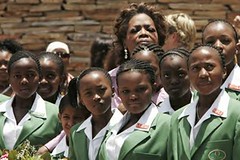
You may know Oprah Winfrey has opened a $40 million school for girls, south of Johannesburg. Apparently this is a greater sum than the US government spent on development in the whole of Africa last year.
Mhambi says many thanks Tannie Oprah. But Mhambi would wonders how many of Nicolas Negroponte's $100 laptops she could have bought with $40 million and if it would not have been money better spent?
A quick bit of maths brings me to believe that Oprah's money could have bought 400,000 laptops. Which is quite allot. Who would she give it to? I would suggest the poorest children in Gauteng.
The South African government has divided all school pupils into 5 categories according to how poor they are. In Gauteng, the smallest but most developed province there are 383,674 pupils in the poorest and largest category. This province would be ideal, relatively densely populated and with good roads, the wireless mesh technology built into the laptops could cast a wireless blanket.
Oprah could have given all of these poorest pupils $100 laptops, and probably could have covered of the next poorest category with what she will need to maintain the school and pay its staff. Just imagine 400,000 plus laptops creating their own wireless mesh all over the province and giving access to the poor to the Internet.
Mhambi is no pedagogue but he reckons that if you give children the opportunity they will learn to use these instruments themselves, without too much hassle, as if by magic. (Many South African teachers have no clue how to use a computer). Imagine the creativity it could unleash?
Now if only the South African government could deal with the predatory monopoly that is Telcom and bring down internet access costs.
And if Joe Modise's estate could repay the £500,000 and $10 million bribes for British Hawks and German subs, we would be looking at another 110,000 plus laptops, and if Shaik and Zuma... Sphere: Related Content
Wednesday, January 03, 2007
Can Californian capitalist hippies save the developing world
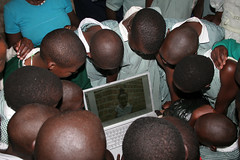
There was a time when a UK academic, Dr. Richard Barbrook, accused the digirati of California of believing in a misleading ideology, the "Californian Ideology".
According to him Net heavy-weights like Kevin Kelly, Esther Dyson and Steve Jobs were beholden to this Californian ideology. A weird hybrid ideology that married ideas associated with the right, free market economics, and those that came from the left, counter-culture libertarianism.
Barbrook said:
"On the West Coast, skilled workers and entrepreneurs in the hypermedia industries form the 'virtual class'. Like the 'labour aristocracy' of the last century, core personnel in the media, computing and telecoms experience both the insecurities and rewards of the marketplace. The Californian Ideology reflects this ambiguity by simultaneously advocating the New Left utopia of the electronic agora and the New Right's vision of the electronic marketplace.
However both left- and right-wing anarchists ignore the key role of taxpayers' dollars in the creation of the PC and the Net. The exclusion of public institutions from the construction of cyberspace can only increase the fragmentation of American society into antagonistic, racially-determined classes."
But today one of the cyber gurus that Barbrook accuses, Nicolas Negroponte, made an announcement that both disproves and supports Barkrook's contention.
Negroponte, head of the Massachusets Institute of Technology's (MIT) Media Lab announced the wonderful news that the first batch of computers built for the One Laptop Per Child project could reach users by July this year.
The One Laptop Per Child Project aims to deliver the children's laptop — a potent learning tool created expressly for the world's poorest children living in its most remote environments.
The laptops will run a bespoke form of Unix operating system where they are encouraged to work on an electronic journal, a log of everything the user has done on the laptop. Because says Negroponte:
"...one of the saddest but most common conditions in elementary school computer labs (when they exist in the developing world), is the children are being trained to use Word, Excel and PowerPoint," Mr Negroponte said.
"I consider that criminal, because children should be making things, communicating, exploring, sharing, not running office automation tools."
The proposed $100 machine will also have a dual-mode display—both a full-color, transmissive DVD mode, and a second display option that is black and white reflective and sunlight-readable at 3× the resolution.
The laptop will have a 500MHz processor and 128MB of DRAM, with 500MB of Flash memory; it will not have a hard disk, but it will have four USB ports. The laptops will have wireless broadband that, among other things, allows them to work as a peer-to-peer mesh network; each laptop will be able to talk to its nearest neighbors, creating an ad hoc, local area network. The laptops will use innovative power (including wind-up) and will be able to do most everything except store huge amounts of data.
Why do children in developing nations need laptops? Why not a desktop computer, or—even better—a recycled desktop machine? Negroponte answers:
Desktops are cheaper, but mobility is important, especially with regard to taking the computer home at night. Kids in the developing world need the newest technology, especially really rugged hardware and innovative software. Recent work with schools in Maine has shown the huge value of using a laptop across all of one's studies, as well as for play. Bringing the laptop home engages the family. In one Cambodian village where we have been working, there is no electricity, thus the laptop is, among other things, the brightest light source in the home.
Why is it important for each child to have a computer? What's wrong with community-access centers?
One does not think of community pencils—kids have their own. They are tools to think with, sufficiently inexpensive to be used for work and play, drawing, writing, and mathematics. A computer can be the same, but far more powerful. Furthermore, there are many reasons it is important for a child to own something—like a football, doll, or book—not the least of which being that these belongings will be well-maintained through love and care.
What about connectivity? Aren't telecommunications services expensive in the developing world?
When these machines pop out of the box, they will make a mesh network of their own, peer-to-peer. This is something initially developed at MIT and the Media Lab. We are also exploring ways to connect them to the backbone of the Internet at very low cost....We are working with the local governments and the private sector regarding how to reduce the cost of Internet access.
This includes connectivity to the Internet from the mesh through gateways at the schools. And how will these be marketed?
The laptops will be sold to governments and issued to children by schools on a basis of one laptop per child. Initial discussions have been held with China, India, Brazil, Argentina, Egypt, Nigeria, and Thailand. An additional, modest allocation of machines will be used to seed developer communities in a number of other countries. A commercial version of the machine will be explored in parallel.
How will this initiative be structured?
The $100 laptop is being developed by One Laptop per Child (OLPC), a Delaware-based, non-profit organization created by faculty members from the MIT Media Lab to design, manufacture, and distribute laptops that are sufficiently inexpensive to provide every child in the world access to knowledge and modern forms of education. OLPC is based on constructionist theories of learning pioneered by Seymour Papert and later Alan Kay, as well as the principles expressed in Nicholas Negroponte's book Being Digital. The founding corporate members are Advanced Micro Devices (AMD), Brightstar, Google, Marvell, News Corporation, Nortel, and Red Hat.
...
To keep the cost down we will market the laptops in very large numbers (millions), directly to ministries of education, which can distribute them like textbooks.
So there you have it. Barbrook was right. Negroponte can not deviler his digital utopia and save the world without the help of not-for-profits, academia and government. But he was wrong because Negroponte is well on his way to actually have an almost unimaginably positive impact on the lives of poor people in the poor parts of the world. Sphere: Related Content