Mhambi is very late with this posting, my summary of Mhambi 2007.
Last year I described 2006 as a watershed year for South Africa in my posting Mhambi's 2006. A year in which open debate returned to South Africa.
If you remember, as Steven Friedman explained, this was not because of a new found commitment to democracy amongst our ruling political class, but because of the battle for control of the ANC and the state between the Mbeki and Zuma camps.
So 2007 started off with many of these 2006 debates carrying into the new year. In these debates Xolela Mangau was one of 2007's most acerbic and eloquent voices against creeping country wide corruption. Others like Rhoda Kadalie waded in.
Steeds De la Rey
There were more heated exchanges at the beginning of the year about the De la Rey song. What did it mean? What would it bring?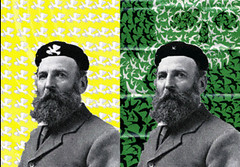
Leeu van die Wes Transvaal
Originally uploaded by Wildebeast1.
Tim du Plessis changed his mind (and not for the last time in 2007) . In 2006 he warned of deliberate Afrikaner civil disobedience, but now announced the arrival of a more confident participatory breed: the New Afrikaner. Pallo Jordan, the minister of Arts and Culture, warned against De la Rey song inspired treason.
The song reached the press in both the UK and US. And in the process it served as an amusing outing of international prejudices about Afrikaners.
But nowhere was its meaning as debated as among Afrikaners. Lefty journo Max du Preez saw in it the worst: racism, atavistic nationalism, a longing for the past. But poets and writers Antjie Krog, Koos Kombuis were not convinced with that line of argument.
But before you think South African 2007 debates were dominated just by a pop song. They were not. By years end it was out of the news completely.
In the US, a debate raged over what extent apartheid could be compared to current events in Israel.
Angola the country South Africa helped wreck celebrated 5 years of peace.
Britain and racism
Rather arbitrarily the BBC decided to screen a blatantly racist tribute to colonial writer Rider Haggart. Perhaps not surprising as in 2007 it transpired that Britain is a society with little self awareness when it comes to racism.
2007 was a year when racism boiled over on British TV, when Jade Goodie and other white Big Brother contestants ganging up on Indian star Shilpa Shetty. The incident had the country in a tizz. The press especially were aghast, while admitting at the same time that the opinions expressed were prevalent in British society.
Many left commentators defended Goody: she was working class, and more likely to be exposed to multi-cultural Britain than her critics they claimed. A good example was Philosopher Julian Baggini who spent six months living in Rotherham, Yorkshire. In the Guardian he professed that he doesn't believe most white Britons are racists - even though he heard racist language almost everywhere he went.
On the cultural and media front trade union solidarity won the global award for the best union website. Gazelle released a funky a stomping Afrikaans electro track, while two movies cataloging life in gay South Africa, screened in London.
Facebook took the world by storm in 2007. Also in South Africa, despite the privatised national telecoms provider Telcom's parasitic and damaging impact on the countries internet ecosystem.
Bad news aplenty
Bad news about the break down of trust and public institutions came a plenty. Many of which, like the Hlophe affair and the scandalous neglect at the Frere hospital Mhambi never wrote about himself.
Wabenzi
Originally uploaded by Wildebeast1.
I did write about the alleged corruption of the National Health minister, who was not fired, even after it was claimed that she was an alcoholic and a thief. Instead the government tried to muzzle the press. There were other posts of Afro-pessimism. Events like the casual destruction of monuments in Standerton helped to spread the gloom.
The astounding growth of crime and the corruption inside the South African police continued to make waves internationally. Journalists like Jonny Steinberg tried to make sense of the corruption and crime.
In 2007 there were less reports of xenophobic attacks on other Africans by South Africans like which transpired in 2006 when scores of Somalis were murdered. Now the focus shifted to extreme indifference towards other Africans best illustrated by the death of Adonis Musati in Cape Town.
There were valiant attempts from South Africans to reach out to each other, like when Hansie Diffenthal tried to save Halaletsang Nkome.
The Rugby World Cup
But so too did the Rugby World Cup loom large. It became clear that racial make up of the South African Springbok team would be an issue. In fact, the ANC also wanted to change the teams ' iconic name.
As the first big match of the cup approached, between SA and England, the English press went to town with prejudicial reporting: South Africans were stupid and not "every inch Western gentlemen". The verbal barrage did not save the English from a battering on the pitch however.
Neither could the spectre of Che Guevarra help the Argentines against a rampant Springbok side.
Jusr before the final The Guardian published a curious rugby article by Gavin Evans, which was duly pulled apart by readers.
Then, despite all this, the Springboks won. And Mbeki tried to surf the wave of glory. The Bok name became non issue.
Mbeki vs Zuma
He certainly needed it. Such was the the growing opposition to his control freakery that too many it seemed that he would loose the election for ANC presidency the end of the year. That placed many South Africans between a rock and a hard place who wanted neither Mbeki or Zuma in charge. Cyril Rhamaphosa entering the race was one of our great hopes.
Mbeki could and did continue to point out how the economy has grown under his leadership. But doubts remained about his success in addressing poverty.
But his Aids denialism still hung over him like a shadow, with Mark Gevisser confirming and explaining it upon the publishing of his monumental biography of Mbeki. 2007 was also the year in which a minimum number was put to the deaths caused by Mbeki's Aids inaction: 300 000.
Another book, Andrew Feinstein's After the Party, cataloged the ANC's move away from democracy and decent into grand corruption. Mhambi cerealised some of it.
By the end of the year it became clear that Mbeki would hit a wall. Some of us, Mhambi included, were optimistic. The inability of the incumbent holding on to power was that the openness had prevailed, a sign of democracy. And so Mbeki did hit a wall. Karplaks!
Better the devil you know?
Down went Mbeki, and enter stage 'left' Zuma. 2008 will no doubt be as interesting.
Tuesday, January 29, 2008
Mhambi's South Africa 2007

Wednesday, June 13, 2007
Whistle blower protected from South African Parliament
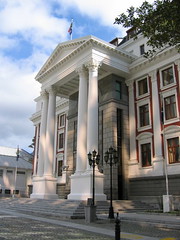
The South African Parliament
Originally uploaded by Wildebeast1.
Such is South Africa: Just when the news from the country gets you down something happens that demonstrates the character and strenght of its people and institutions.
Acting Labour Court Judge Mzo Ngcamu this week ruled that it would be a national embarrassment if Harry Charlton was found to be unprotected by whistle-blower laws. Ngcamu said it did not make any sense for Parliament to make laws that protected whistleblowers and then have those laws not apply to MPs who were guilty of criminal activities.
Parliament’s efforts to avoid explaining publicly why it fired former chief financial officer Charlton have suffered a major blow following Ngcamu's Labour Court ruling that Charlton was protected as a whistle-blower.
Charlton has consistently insisted that he was dismissed and persecuted as a member of the parliamentary staff for blowing the whistle on MPs guilty of stealing about R20m of taxpayers’ money in the Travelgate scandal.
Secretary to Parliament Zingile Dingani has said that Charlton was fired for financial mismanagement.
Ngcamu said: “The conclusion I have come to accords with the purpose of the Protected Disclosures Act to root out corruption. The applicant is protected by the PDA. To hold otherwise would deal a blow to government intentions and would be a national embarrassment.”
He said “evidence still has to be led to establish the true reason for the dismissal. It is only where such evidence has been led that it can be said whether the court has jurisdiction or not”.
The Open Democracy Advice Centre, which runs a special service to the public on access to information and whistle-blower protection, said it welcomed Ngcamu’s judgment. A spokesperson said: “We are particularly pleased that the judge underlined the absurdity of an outcome where staff in Parliament could not blow the whistle on corruption perpetrated by MPs.”
Thursday, March 22, 2007
The sultans of bling
This privatisation of public resources is happening on a grand scale in our country. You know that a problem is endemic when it begins to assume all kinds of colloquial descriptions in everyday life. Wherever I go, people talk about “the loot”.
Xolela Mangcu
Sphere: Related Content
Tuesday, March 20, 2007
The sultans of bling
Sphere: Related Content
Saturday, January 20, 2007
BAE and South African government corruption cuts deep
Britain's PM Tony Blair would like to be remembered as a leader of a country with a ethical foreign policy. Why then has he tried to block investigations by Britain's serious fraud office into corrupt BAE dealings in Saudi Arabia?
And would he dare do the same for yet another BAE deal reported in 2003?
Britain's biggest weapons manufacturer, BAE Systems, paid millions of pounds in secret commissions to obtain a huge UK taxpayer-backed contract to sell Hawk jets to South Africa.

Blair - hawkish self interest
Mr. Blair says investigations into BAE's dealings should be blocked so British relations with countries like Saudi Arabia should not be ruined, not forgetting to add that he has to protect British jobs.
But the press has refused to drop this issue. The Guardian has rejoined the fight agianst BAE with evidence of their corrupt dealings in South Africa and elsewhere claiming last week:
The SFO is also pursuing its investigations into allegations that BAE made corrupt payments to politicians and officials in Tanzania, Chile, the Czech Republic and Romania....
But its the South African deal which is attracting the most scrutiny:
South Africa's airforce chiefs had selected Italian aircraft as cheaper and more modern, but the amended specifications shifted the balance in favour of the ageing British Hawks - at nearly double the price.
The Hawks are part of a £1.5bn package BAE and Saab put together to supply 24 Hawk fighter trainers and 28 Gripen light fighter aircraft to South Africa. Sources in the country say the request to the police indicates that the SFO investigation extends beyond the sale of the Hawk aircraft to the payment of bribes in South Africa and other developing countries.
So how much money are we talking about?
In the race to win contracts, BAE built a tangled web of relationships with South African officials, particularly Mr Joe Modise, the ex minister of defence who it is thought received at least £500,000's directly.
BAE acknowledges that it paid tens of millions of pounds in secret commissions to win the £1.5bn contract. The arms company originally intended to pay 12% of the contract price in commissions but agreed to cut that back to 7% - more than £100m - following questions from the British authorities underwriting the deal.
Modise also received more than $10 million from a German company to supply south Africa with sub-marines. Sphere: Related Content
Monday, November 27, 2006
SA police commisioner Jackie Selebie corruption allegations grow

Allegations about Jackie Selebi, SA police commisioner and head of Interpol and his relationship with corrupt individuals have now made it into newspapers outside of South Africa, the UK Guardian featuring it prominently on Monday.
South Africa's national police commissioner, Jackie Selebi, is under investigation after it was revealed that he maintained a close friendship with an organised crime boss recently arrested over the murder of a corrupt mining magnate. Read more.