In the last week two interesting more pieces have been written about Zimbabwe and what it portends for South Africa.
In the first, Gavins Evans, former journalist, and member of the ANC underground tells of his travels to Zimbabwe in the 80's. Evans worked and recruited for MK the ANC's armed wing.
He tells of the ANC's difficulties with ZANU and the awareness of ZAPU persecution, but that Real politik made them look the other way. Evans has a little sympathy for ZANU. Afterall Britain had not met their obligations for land reform he says.
Evan's lists why he thinks South Africa will be different. And the answer is primarily a much more active civil society.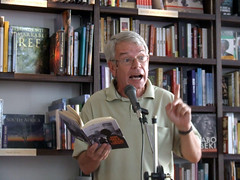
Jeremy Cronin
Originally uploaded by BOOKphotoSA.
In the second, Jeremy Cronin, the South African Communist parties deputy general secretary, echoes much of Evan's thought. South Africa's battles were fought by trade unions, journalists and a plethora of other civil society groups he says.
And interestingly he alludes to the fact, as I mentioned in a previous post, that it is precisely because MK was unsuccessful militarily that one of he primary engines of potential ZANUfication is not present in SA. The ANC had to rely on the broad South African public.
Cronin also has this to say about Mugabe's insistence that its Britain's fault the land reform program failed.
We are told, for instance, that ‘land reform’ did not succeed because the British failed to meet their financial obligations as agreed in the Lancaster House negotiations. But what kind of heroic anti-imperialist liberation movement is this? Can you imagine the Cubans arguing two decades after their revolutionary breakthrough that they had not implemented land reform because the US refused to subsidise it?
Well said.
Wednesday, May 07, 2008
Zanu ain't no heroic Cubans

Wednesday, April 09, 2008
Afrikaner vs Cuban: the irony of Cuito Cuanavale
Once tentative talks between South Africa, Cuba, Russia, and America commenced early 1987 about the end of the Angolan War and Independence for Namibia, Pik Botha, South Africa's long serving foreign minister thought it time for the Cubans to get a history lecture.
This article continues from Cuito Cuanavale - background to a Battle.
In a rhetorical flourish at one of their meetings Botha made it abundantly clear to the astonished Cubans that Afrikaners have a proud history on the battlefield. After all, they had withstood the might of the British Empire, no less than a half a million troops, for 3 years. Don't underestimate our resolve, don't mess with us, was the message.
But Afrikaners would have done well to also learn and understand the history of their opponents, the Cubans.
The Nationalists had form in this regard. They had consistently underestimated the role of the Cubans, thinking they were mere pawns of the Soviets. When in 1975 Cuba jumped to the rescue of the Angolan MPLA, Pretoria thought it was at Russia's bidding. In fact it was, at least originally against Russia's wishes.
But to be fair, neither did the US believe the Cubans were acting on their own initiative. Nobody believed that such a small developing country would project military power at such a range.
Nevertheless, a bit more knowledge about the Cubans could have given the Afrikaner Nationalists pause for thought about the motives that drove their enemy. Perhaps a clue as to their intent, their determination and the way they would react in battle.
More importantly it could have given them a glimpse of what Afrikaners themselves could have been. A chance imagining themselves differently.
But why would Cuban history have resonance with Afrikaners?
Come the mid 1980's Afrikaner leaders might not have admitted it, but they felt sullied. Their intellectuals were decrying them, their writers were claiming 'Ons is nie almal so nie'. (Were not all like that).
Strange because Afrikaners had part of their identity a grand sense of being a people battling injustice. They had, as Pik pointed out, fought a fierce anti-colonial war of liberation against a European superpower. An act that had become part of the core of Afrikaner identity.
But so had the Cubans. And at more or less the same time at the turn of the previous century. In fact the Cuban and Afrikaner struggle dovetailed and even influenced each other.
But for all his huffing and puffing Botha knew they were not seen as freedom fighters but as apartheid: they were racial domination and colonialism personified.
The Cuban delegation lead by Jorge Risquest did not suffer this fate. Increasingly they reveled in the role as the anti-colonial, anti-racist revolutionary force in the world.
Considering all this, that it came to be that from 1975 Afrikaner and Cuban came to face each other in Angola, is a surpreme irony. An irony that both sides were blissfully unaware of.
Cuito Cuanavale the last big battle of the Cold War would be a fitting grand finale.
Raising the stakes
Make no mistake, although the MPLA's Fapla, and UNITA's army represented by far the majority of troops on the ground, and suffered the majority of the casualties, they were the light weights in this crowded ring. The SADF's Colonel Breytenbach had famously described his allies Unita as "useless". No doubt thought the same of the MPLA's troops who he routinely routed. The only Angolans in the conflict whose military prowess he valued was those fighting in his 32 battalion.
The Soviets's never really stepped into the ring but preferred to provided ample resources, intelligence training and weapons. The US also provided resources and weapons, but they did it in secret and at a much smaller scale.
It was the Cuban and South African army that raised the military game at crucial junctures. Without one of them the war would be over in weeks. The South African army was made up mostly of both English and Afrikaans speaking whites. But it was Afrikaner controlled, it spoke Afrikaans and had gone into this conflict at least partly at the behest of Afrikaner interests.
But where is the irony?
But lets go back to 1901 to the second Anglo Boer War. South Africa's Boers' military guerilla exploits were making world news. But the world was also startled about the shocking reports of non combatant mortalities. Boer Commandos
In a report Concentration camps in November 1901 in the New York Times the link between South Africa and Cuba is made.The nearest prototype of the camps of concentration established by Lord KITCHENER in South Africa were those established by Gen. WEYLER in Cuba.
The newspaper speculates that at the rate of mortality all the South African "reconcentrados", (the Spanish word used in Cuba) will be dead in 4 years time:'When South Africa ceases to be in a "disturbed condition" It seems that it will be because the invaders "made a solitude and called it peace." '
The New York Times were of course comparing events in South Africa in 1901 to those that had gone before in Cuba's Third War for Independence from Spain that started in 1895.
Spanish tactics were remarkably similar to what the British followed in South Africa from 1900. Most probably because the British emulated them. First they used trochas to limit the movement of the Cuban rebel army. The History of Cuba website explains the trocha system.
The trocha was "a broad belt across the island," about two hundred yards wide and fifty miles long, designed to limit rebel movement to the eastern provinces. Down the center, a single-track military railroad was equipped with armor-clad cars, and various forts and fortified blockhouses were built alongside. A maze of barbed wire was placed so that every twelve yards of posts had 450 yards of barbed-wire fencing. The fortified houses featured loopholes and trenches on the outside, and many encircled windows from which Spanish soldiers could observe and fire.
This was not at all dissimilar to the British Blockhouses that carved up the South Africa landscape, when the Boers started their guerrilla campaign. The British linked the blockhouses with barbed wire fences to parcel up the wide veld into smaller areas easier to control the marauding Boer Commandos.
Next came a "Scorched Earth" policy under which they targeted everything within the controlled areas that could give sustenance to the Boer guerrillas with a view to making it harder and harder for the Boers to survive.
As British troops swept the countryside, they systematically destroyed crops, burned homesteads and farms, poisoned wells, and interned women, children and workers in concentration camps.
But this too had its antecedent in Cuba. Spanish General Weyler implemented a system of what he called “re-concentration”. In this system various fortified areas were designated, and all inhabitants were given eight days to move in, including cattle and other animals. Anyone caught outside was considered the enemy and killed. It is estimated that up to 200,000 Cubans died in these Concentration camps.
By the end of 1897, there were 240,000 regulars and 60,000 Spanish irregulars on the island. Like the Boers, numerically the Cubans was supposed to have no chance.
Winston Churchill had travelled to South Africa to cover the Boer war. But a few years earlier he was in Cuba.
Writing in New York's Saturday Review, Winston Churchill expressed reluctant concern at the fact that "two-thirds of the Cuban rebels were black," adding that it would be beneficial to US. interests if Spain kept control of the island.
Cuban figthers
But the Americans were concerned by the deaths and suffering in Cuba. But the way in which this concern was expressed had made the Cuban rebels suspicious. Not that the USA would follow Churchillian advice and support the Spanish mind you.
They suspected that the Americans had other ulterior motives. The fears proved well founded when the US joined the War against Spain and annexed the island.
By then Cuban commanders had realised the importance of sizing the west of the island. Failing to get the west was partly why they had not managed to won in the previous wars of independence. In a daring mission lasting ninety days, the invading army went from its eastern tip to the western end traveling a total of 1,700 kilometers and fighting 27 battles against numerically superior forces.
The History of Cuba website explains the situation when the US entered the War:'By the time the US entered the war in 1898, Spain was running for cover, and a Cuban victory was certain. The Spanish troops had been forced back into the urban areas, making them easy targets. The rebels controlled the countryside, and the Spaniards found it impossible to retreat.'
On August 11 Spain accepted the peace terms, in which the US received control of 4 new territories: Cuba, Puerto Rico, the Philippines and Guam.
Although the treaty officially granted Cuba's independence (anti-imperialists in the Senate had made sure that laws were passed excluding Cuba from becoming a US territory), it was the US flag, not the Cuban flag, that was raised over Havana, and during the surrender ceremonies in Santiago de Cuba, US General William R. Shafter refused to allow Cuban General Calixto García and his rebel forces to participate.
In December 1898, one year before Boer forces thwarted British dreams to be home in Britain in time for Christmas, Cuba faced a new invasion.
A US newspaper wrote “Whatever may be decided as to the political future of Cuba, it’s industrial and commercial future will be directed by American enterprise with American capital.”
The American provisional military governments, which controlled Cuban money, refused to provide loans to farmers and landowners.
Foner a historian wrote:
“This was the legacy of American military occupation, and the refusal to permit the use of the funds belonging to the Cuban people to assist the small farmers and planters to retain their land and rebuild their properties, damaged or destroyed during the Revolution.
…Americans were most ‘energetic’ in picking up land at low prices from people who were without means, and for whom the Occupation government refused to provide loans so that they could develop their property.”
Concessions for the railway was won by American companies, and soon the sugar and tobacco industries once controlled by the Spanish was American. American newspapers and Generals urged their government to incorporate the island into the US against earlier legal provisions.
Like Lord Milner who governed South Africa after the Boer War, and who regarded Afrikaners as ignorant and who wanted the country to be incorporated into an English Empire for its own good, US news papers were plugging for much the same in the case of Cuba.
An editorial in the New York Sun, on April 13 1900, summed up the pro US point of view. “The attitude of the people of Cuba toward annexation seems to be this in brief; the wealth and intelligence of the island are generally in favor of it, and the agitators and their tools, the ignorant Negroes, are opposed to it.”
Black or mixed race Cubans had allot to worry about. The US view on race now held sway on the island. It was even suggested that black Cubans had not made an equal contribution to the war.
In 1901, US military governor Wood expressed the need to "whiten" the Cuban population.Governor Wood's attempt to create an all-white-Cuban artillery corps led to strong opposition from veteran leaders of the Liberation Army. According to Pérez, "white (Cuban) veterans made it clear that there was a blatant contradiction between the integrationism of Cuban nationalist discourse and the segregationist policy of the U.S. Government of Occupation."
In the objection of white veterans to this attempt to exclude black Cubans lies much of what makes Cuba exceptional, not just to South Africans, but to other nations as well.
Cuba had already long history of struggle for racial unity. In fact it could be said that this search for racial unity had already by 1901 become integral to Cuban identity.
But why was Cuba so different? Why this commitment to non racialism that has bedevilled so much of the rest of the world? A comparison with the identity formation of Afrikaners is instructive.
(To be continued)
Thursday, March 20, 2008
Cuito Cuanavale - background to a battle
Recently progressive politician Van Zyl Slabbert pleaded with South Africans “not to fall for an invented history”. This included what he called the myth that Cuban and Angolan forces had defeated the South African Defence Force (SADF) at the Angolan battle of Cuito Cuanavale.
Underlining its resonance just this week the president of the ANC, Jacob Zuma and a delegation from the South African parliament is visiting Quito Canavale.
Why is Cuito Cuanavale seen as so incredibly important and the site of so much argument? It is said the battle which commenced in September 1987 was the largest land battle in Africa since World War 2. Is that it? What exactly transpired there, and what was at stake then and is now?
Slabbert claims that South Africa’s struggle past was being selectively used to establish a racially exclusive Africanism as “the new dominant ideology”. And the debate over Cuito is part of this trend.
A massive argument now rages about who actually won at Cuito. Right after the incident Fidel Castro had already achieved several media coups with his claim that Cuban forces had secured major victory for the Angolans over the racist apartheid army.
South African generals deny this claim to this day by pointing to its low casualty rate (just over 20) compared to the Cubans and Angolan MPLA. And they claim that its army never intended to take Cuito Cuanavale.
Several assumptions and points of departure in the argument about Cuito Cuanavale are however misguided.
One glaring mistake that is often made in the debate about Cuito is not mentioning the role of Unita on whose side South Africa fought. Another is not explaining the background and what lead to it. More specifically:
- the spectacular South African military victories up until then,
- the change in weaponry,
- the pressures on both South Africa and Cuba,
- the Nationalist's aversion to taking casualties.

Why Cuito Cuanavale
Cuito Cuanavale is a town a few hundred kilometers inside Angola and towards the vast countries east. It is a gateway of sorts to the whole South eastern region. It was also importantly barely within range of South African fighter planes.
It is situated on the banks of a river and had been a centre from which Angola's MPLA had launched attacks on Mavinga in south east Angola for a number of years.
Each season starting 1984 when the rains allowed them they struck out south east along the Lomba river.
The actual target was Jamba, Unita's bush head quarters. This south east of Angola was sparsely populated by the ethnic group loyal to Unita, with nothing much else but bush. On the South African side of the Namibian border there was not much else either, except the base of crack SADF units like 32 Batallion.
Jamba, a magnet for trouble
Many SADF personnel including Jan Breytenbach the maverick head of 32 battalion had for some time questioned the wisdom of setting up a formal fiefdom by Unita at Jamba.
It would encourage just these kinds of large conventional attacks by the MPLA it was thought. It presented a prize target, and if taken would be a massive propaganda coup. It was argued that it would be much better if the movement remained as a guerrilla army.
As apartheid South Africa suffered from an international arms embargo it wanted to avoid conventional warfare. On paper the Russian backed MPLA had superior weaponry in many areas, not to mention its tank capability.
The Russian military loved these large formal troop movements, and actively encouraged the MPLA to attack in this way. The Cubans on the other hand, who also had a strong presence in Angola, and had so heroically and audaciously helped the MPLA in 1975 begged to differ. They thought the Russian strategy to be ill conceived.
The Angolans often fled in the face of South Africa attacks, and so landed Unita with valuable Russian military hardware.
To the Cubans the Angolans would be much better served if they also followed a guerrilla strategy. And if they were to strike with conventional power, they thought a strike down the south west would be much more effective than the south east.
This is because South Africa presented more targets in this area, one of which was the Calueque hydro electric dam. It supplied much of Northern Namibia's electricity and was built with South African money. There were also many settlements and the odd town on this side of the Namibian border.
But since 76, the Russian opinion held more sway with the MPLA. In September 1984 one of the first large attacks by the MPLA from Cuito Canavale towards Mavinga took place. It was stopped in its tracks.
The SADF supporting Unita - primarily with their Mirage fighter airplanes - destroyed the advancing MPLA columns. The MPLA was pursued, but importantly not all the way back to Quito itself.
Much the same would happen the next year in September 1985 when the MPLA backed by the Russians attempted exactly the same. Their columns were disrupted, they were pursued, but Quito was not attacked.
The question has to be asked why Quito Cuanavale was not attacked as it tells us much of what transpired later.
The pressure mounts
If the South Africans were enjoying military success outside of the country, inside South Africa the situation had changed dramatically. Swart September 84, which began in, Sharpeville caused riots throughout the country. In 1985 more than 30,000 SADF soldiers would be deployed to quell the riots inside the country. This drew heavily on the resources of the SADF.
The country was also being crippled by economic sanctions. The occupation of Namibia was gobbling up a large proportion of the South African budget. And increasingly white soldiers were not showing up for compulsory military service.
Earlier on in the conflict the Nationalist Government indicated to its military that it was risk averse. Risk averse in the sense that it thought the white voting public in the Republic would not tolerate much by way of white casualties.
This is probably the main reason why the SADF had not sent large numbers of ground forces to destroy Cuito Cuanavale. It was just not prepared to take that political risk.
Instead it fell back on the services of the South African air force and mainly black guerrilla units like 32 Battalion to defend Unita's Jamba when needed.
In Namibia the conflict against Swapo's Plan army had been contained but at great financial cost. Swapo, starved of resources had been an exceptionally brave opponent. Although Swapo fighters crossing the border on foot were almost always captured or killed, they just kept coming.
1986 saw much the same pattern of conflict emerge. But a few other changes was afoot. The South African government's arms project had began to deliver. The South Africans now had some of the best long range canons in the world. In two more years time they would also see the fruition of even more sophisticated weaponry.
The Cold War winds down
But the world was changing as well. Come 1987 the Russians had already indicated to the Cubans that they were interested in some negotiated peace. The Soviet Union was in retreat. So too was Cuba and its economy suffering come 1987. The treat of diminished Soviet economic support loomed large for Cuba. Internally there was much talk of dissent to the Castro regime.
PW Botha had already started a tentative secret process to talk to Mandela, while the Russians, Americans, Cubans, Angolans and South Africans had started tentative talks about ending the conflict.
It is here where to me it seems two fierce characters, PW Botha and Fidel Castro, and their inflated egos took the decisions that would shape what transpired at the now mythical accounts of Quito Cuanavale. One of them would do better than the other. A victory of sorts was on the cards.
Afrikaner vs Cuban the irony of Cuito Cuanavale Sphere: Related Content
Thursday, November 29, 2007
Niemand, truth and innocence lost at Cassinga
In May 1978 South Africa launched their largest offensive paratroop operation ever. The target was Cassinga, a little Angolan town a few hundred kilometers from the Namibian border. When the recriminations flew soon after, the South African Defence force claimed it had been a large SWAPO base. SWAPO claimed it was a refugee camp.
A participant in the attack suggested to Mhambi - as if it exculpated - that their intelligence showed that there was, besides a considerable military presence, a brothel at Cassinga.
There certainly were civilians, and so was the head of SWAPO's armed force PLAN, Dimo Amaambo, on the day of the attack. Cuban presence was 15 km south of Cassinga, at the village of Tetchamutete (Chamutete).
View Larger Map
At the time an international solution, namely independence for Namibia was on the cards. Amazingly prime minister Vorster's cabinet had already approved the plan in principle. A plan that would see international monitors conduct a multi-racial election for the South African administrated territory.
Then, barely two weeks after after the cabinet approval, at the insistence of the aggressive defense minister P W Botha, the attack on Cassinga came.
The South African attack began at dawn, and comprised several bombing raids and a large paratroop jump led by the larger than life Colonel Jan Breytenbach.
The jump went partially wrong and several paratroops landed in the marshes and river that bordered the town. One soldier that fell in the water told how he stood on the tip of his toes. He could barely lift his head above the water. His heavy equipment held him down. But passing South African troops saved him when they heard his cries.
The soldier just behind this one in the jump, one Niemand, was never seen again.
After the bombing raids and after the paratroopers had reorganised heavy fighting ensued.
The Cubans came to the aid of Cassinga with tanks and armed vehicles. Still 1000 inhabitants of Cassinga died that day, many of whom were women and children. And with them the peace deal was swept off the table.
The War would continue for 12 more years.