The other day jewish South Africans on It's Almost Supernatural were in a tizz about a letter.
"The letter entitled “We fought apartheid; we see no reason to celebrate it in Israel now!” angers me on so many levels, but none more so than the official endorsement of the letter by the ANC."
Commentator after commentator criticised the ANC as if the end was nigh.
"The logic is quite simple. The ANC (rightly) hates supporters of South African apartheid. If they believe that Israel is an apartheid state then they will hate Israel and its supporters. So if you are a Zionist, let it be known, the ANC officially hates you and would probably prefer it if you left South Africa. If there was no affluence in the local Jewish community, I wonder whether we would still have our place in the South African sun?"
And then I replied:
'This is not logic guys. How can you infer that they would probably prefer that you all leave?
Get a sense of perspective. Jeez. Gary goes on about the murders in Israel. There's no accurate tally but it's been suggested that more than 2000 farmers have been killed in this country since 1994.
You guys are not half as threatened as Afrikaners are and your going on as if the world has ended. If I was you I'd concentrate on defending what you have already achieved - Israel - by making some justified concessions and ignore the ANC.
At the rate things are going now your going to be a minority in your own country and you'll be screwed. Get rid of the illegal settlements for your own sake.'
My point was that Afrikaners are more at peril, because it's a language based identity. The Jews have a state and besides they have a religious based identity and not a language based one. The children of Afrikaner emigrants won't speak Afrikaans.
But a certain contributer, Blacklisted dictator commentated pointedly:
""Afrikaners "have a language based identity" which would be lost by emigrating. If that is the case, it might be better to lose your culture rather than your life?...
If speaking Afrikaans is the be all and end all of your culture/existence, then you should perhaps have a re-think about the meaning of your life. However, I have a clever solution to your dilemma..learn Dutch and emigrate to Amsterdam. It is a great city. Much better than Pretoria or Stellenbosch...
If being Afrikaans is "more than a language", what else does it include?
I supposes, it is primarily direct contact with other Afrikaners in South Africa? The question still unfortunately arises whether Afrikaners have a sustainable future in South Africa. I believe that they don't. As I have previously stated all colours and all faiths should make plans to get out."
And then the coup the grace.
"Would it be a loss to me if this planet lost the Afrikaans culture?
I think that you should put this question in context. Many many cultures are being lost annually throughout the world. It is a sad fact of life."
Indeed, would it be a loss to the world? Would it be a loss to Afrikaners? Does it matter?
I decided not to answer the Blacklisted Dictator. Instead, inspired by Andries Bezuidenhout I made a little compilation of Afrikaans songs about emigration, loss, verlange and heimwee.
Andries was queried about Afrikaans by Wits Phd student Mandisa Mbali recently. Mandisa asked him why he sings in Afrikaans, a dying language? Andries replied, "We want to give it a beautiful funeral."
Enjoy.
Afrikaner diaspora songs (best when flying or driving)
When things are going well...
Originally uploaded by j.dubb.
Playlist
Rian Malan - Trekboer (About missing Africa but being scared of it)
Gert Vlok Nel - Epitaph - (About dreaming of being as far away as possible)
Koos Kombuis - Vêr Van Die Ou Kalahari (About feeling guilty about running away)
Valliant Swart - Banneling (About being an exile)
Andries Bezuidenhout - Bus na Toronto (Remembering the struggle and wars from the safety of the North)
Gert Vlok Nel - Moenie My Hier Vergeet Nie, Dixie (The angst of being left behind in a country where whitches are still burn't)
Gazelle - Die Verlore Seun (Bright lights big city - cause there's a whole world out there - Careful, includes hidden track)
Monday, June 09, 2008
No Afrikaans - Would it be a loss to the planet?

Tuesday, March 04, 2008
Afrikaner groups come out against video
What was depicted in the video was “particularly bad” for those Afrikaners who were acutely aware of the apartheid past and were trying to “reinvent and re-imagine” themselves, Du Plessis said.
The Business day reports what Tim du Plessis editor of Rapport had to say about Afrikaner reaction:“It was flashed all over the world, and everyone is thinking that all of us are responsible. Not all of us are the same,” he said.
It was indeed flashed all over the world. Mhambi spent this weekend in New York, and an Afrikaans friend of mine who works as an editor in Brooklyn was queried by her black colleagues about it. She was surprised that all of her black colleagues got to know about it, before she did. It demonstrated the how keenly this incident is felt by the global black community in particular.
Mhambi is therefore very pleased Afrikaner groups made a strong joint statement this weekend condemning the racist video made at Free State Universities Reitz hostel.
Eleven Afrikaans organisations issued a joint statement at the weekend condemning the video.
The incident, in which the students made workers at the university take part in “disgusting” initiation rites, was “unconditionally rejected”, the organisations said.
It was signed by the civil society lobby group AfriForum; the Afrikanerbond; the Afrikaanse Taal- en Kultuurvereniging (the Afrikaans Language and Culture Organisation); Dames Aktueel; Dames-kring; Federasie van Afrikaanse Kultuurorganisasies (the Federation of Afrikaans Cultural Organisations, or FAK); Regslui vir Afrikaans (Lawyers for Afrikaans); Rapportryers- beweging; trade union Solidarity, SA Akademie vir Wetenskap en Kuns (the South African Academy for Science and Art) and the Voortrekkers, a youth organisation.They denounced the incident as a misguided way to highlight legitimate concerns about decisions taken by the university’s management.
“Afrikaans students in SA have valid democratic goals.
These ambitions encompass the future of mother tongue education, unlimited access to academic institutions and the quality of education.
“Incidents such as this damage these strivings,” the organisations said.
Wednesday, January 30, 2008
Siener - Rian Malan's comical take the future
Talking of Music videos, here is Rian Malan's Siener video - a little sweetner for those Afro pessimists out there.
Malan's dog Tommie can see the future. Don't say you have not been warned.
It ends with the line, even if everything goes wrong for 50 years, in the end we will have a jol in Africa.
NuL - the online superstars
NuL has recently released an video to accompany their song, Online Superstar. As with everything else NuL does, they made the video themselves, in downtown Pretoria South Africa nogal.
NuL also has an excellent website where you can download all their tracks for free through the creative commons license.
Read more about NuL on wikipedia.
And Nul is great live.
Friday, November 16, 2007
Canada's struggles does and does'nt mirror that of South Africa
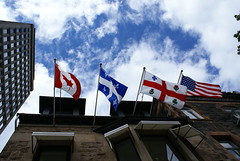
need more flags?
Originally uploaded by JukeBox.
Mhambi is in Montreal, Canada. Now, Montreal is the capital of the Quebecois (see correction below). That is to say, the French speaking bit of Canada.
A few observations. English speaking Canadians - at least the ones I observed - make no effort what-so-ever to try and speak even the most rudimentary French in shops etc. Most of the French Canadians speak English, often begrudingly. So in that respect its a bit like in South Africa.
In the past the creation of Canada had a very direct influence on South Africa. The governor of the Cape, Mr Frere, got some of his ideas for a grand confederation of South Africa (incorporating the Transvaal, the Cape, the Free state and Natal), from the Canadian federation between the French and English speaking peoples of Canada. (Of course he was only considering the white South African population when making these plans, as did the Canadians.)
The difference and the problem for Frere of course was that while the English speaking Canadians outnumbered the French ones in Canada, the Boers of the Republics and the Cape Afrikaners outnumbered South Africa's English. In fact South Africa was and is home to the largest Anglophone community in the world without direct political power.
The other marked difference, and this you notice today, is that neither the French or the English Canadians saw themselves as not connected to their colonial motherland. It was almost as if the cross English channel battles were transplanted: In the form of cultural wars on Canadian soil.
On the English side of Canada you find Royal this, and Elisabeth that, while the Quebecois flag, Montreal Street and suburb names are all full of references to France.
None of them were and are now calling themselves something like Afrikaners or Americans. They were or are colonials and proud of it.
Another difference is that there is very little sign here of the original inhabitants of Canada.
Friday, August 03, 2007
Facebook's posh Afrikaans haters makes for uneasy sleep

bakkiesboek
Originally uploaded by Wildebeast1.
Last week Mhambi was checking out his personal Facebook Newsfeed. The feed, described by Sam Leith as "the Reuters of irrelevance, the AFP of inanity" should really not be that important.
But not that day. I could see that my friends were joining and leaving a group called "Afrikaans is a dying language, LETS KILL IT!".
Soon some of my friends sent me an email, help report that group, it's hate speech. They were clearly upset, and so I have to admit, was I.
The group is managed by a Simon Nova (South Africa) calling himself as being from the Anti-Afr. ELITE. He is assisted by Charles Killer (Portsmouth) for the British Rep? Mmmm...
And on closer inspection one Mhambi decided that one should probably not be so bothered. The group appears to be a bunch of i'll informed teen age posh tossers, nothing more.
Except it did upset me much more than I thought. But Why? Mhambi has gone on record to say that having many languages in one country is problematic. Still that night I slept very badly, and woke with a terrble sense of dread. I jumped out of bed, to some sound in our lounge.
Half asleep and convinced that we have a killer in our flat I stormed out of the bedroom. Only to find my girl friend's perplexed brother. Weird. Us Afrikaners are full of fright.
 Sphere: Related Content
Sunday, June 10, 2007
JM Coetzee translates Ina Rousseau's Eden

Company Gardens, circa 1965
Originally uploaded by mallix.
JM Coetzee's Notes on Eden published in Poetry magazine:
Ina Rousseau's poem "Eden" was published in 1954, at a time when white Afrikaner nationalists were riding the crest of a wave: internally they were on the way to crushing opposition to the apartheid state they were building; externally their strident anti-Communism had ensured the support or at least connivance of the West. The future they promised their adherents was prosperous and secure. "Eden" is thus a surprising and disturbing text to emerge at this moment, from the hand of a young Afrikaans poet not known for politically divergent views.
Traditional in its form and imagery, "Eden" is nevertheless a cryptic poem. Internally it bears no trace of South Africa—no trace, that is, save the language in which it was written. But once the key phrase "South Africa" is breathed, the poem opens like a flower. The first European settlers were planted at the southern tip of Africa to supply the Dutch merchantmen sailing to the East Indies with fresh fruit and vegetables. The garden they laid out—the so-called Company Garden, still standing in the heart of modern Cape Town—is linked by Rousseau with the paradisal garden of Judeo-Christian myth, and hence with the promise of a new start, a return to an unfallen state, that operated so powerfully in the European colonization of the Americas.
Eden
by Ina Rousseau
Somewhere in Eden, after all this time,
does there still stand, abandoned, like
a ruined city, gates sealed with grisly nails,
the luckless garden?
Is sultry day still followed there
by sultry dusk, sultry night,
where on the branches sallow and purple
the fruit hangs rotting?
Is there still, underground,
spreading like lace among the rocks
a network of unexploited lodes,
onyx and gold?
Through the lush greenery
their wash echoing afar
do there still flow the four glassy streams
of which no mortal drinks?
Somewhere in Eden, after all this time,
does there still stand, like a city in ruins,
forsaken, doomed to slow decay,
the failed garden?
Translated from the Afrikaans by J.M. Coetzee
Read more notes by Coetzee on Eden.
Sunday, January 21, 2007
No Afrikaans please, we don't discriminate
Now here's an interesting case reported by the SA Times, the South African london newspaper. Bear in mind that this report comes at a time when the press is up in arms that the British tax payers is paying millions in translating information for public services. But Mhambi hazards a guess that nothing is spent on translating anything into Afrikaans, (or Zulu and Sotho for that matter).
Two South African companies offering accommodation to “young South Africans” have been told to change their websites as they are discriminatory.
Many South Africans would like to believe that they have left the legacy of apartheid and racism behind them – so much so that when they are confronted with allegations of racism, it comes as a bit of a shock, and more so when it is in the realm of business.
Two such companies are Ultimate Housing and Homes Africa, both of which offer housing to South Africans.
While both claim that they do not discriminate on the grounds of race against anyone seeking their services, the Commission for Racial Equality has found their websites to be discriminatory and, following investigations, has requested that they make certain amendments to their sites.
Ultimate Housing’s website (www.ultimatehousing.co.uk) has been found to be discriminatory because, firstly, it offers it’s services to South Africans: “young independent South Africans”. Secondly, their website is in two languages, English and Afrikaans.
Quoting section 29 of the Race Relations Act (amended 2000), Agnes Namoh, who works within the legal services department of the Commission for Racial Equality, said “anything that you publish or cause to be published – that means that you are either an advertiser or a publisher – which indicates an intention to discriminate, is unlawful”. This she says indirect discrimination.
“You can’t advertise solely for a section of the population,” she said. “An advert should be for everyone. Racial discrimination includes race, but it also includes nationality and ethnic origin.”
Namoh explained the fact that a section of the website is in Afrikaans relates to the first complaint that the website is targeted at South Africans.
Quoting section 11A of the act, Namoh said: “English is the spoken language – when you advertise in another language it is indirect discrimination, because the majority of the people who can understand what you are saying have to be Afrikaans. There is no reason for it unless you have the intention to discriminate.”
Speaking from the perspective of a non-South African person, she said that should you go on to the website, the first thing you would read was that Ultimate Housing offers services to South Africans, giving the impression that it excludes all others. The fact that the website is translated into Afrikaans narrows the field even further.
Having parts of your business website in Afrikaans is not illegal as such, as long as you can justify your need for doing so.
“The law states that you might be allowed to advertise in another language if there is justification for it – it is proportionate and it is to achieve a legitimate aim,” she said. Namoh explains that in Ultimate Housing’s case, their Afrikaans section cannot be justified because it would reasonably be expected that any Afrikaans person who comes to the UK to study or work would be expected to have a good understanding of English. Danie Engelbrecht, co-owner of Ultimate Housing, is adamant that there was never an intention to discriminate. He said that, while most of the people he houses are South Africans, he has also provided accommoation to Australians, Poles, New Zealanders and Americans.
“We have quite a few different people so there really is no motivation for us to be racially unequal,” he said. “I don’t think that we exclude anybody anywhere – we’re just saying who our main target market is. There are loads of advertisers all over the UK that would advertise for a certain group of people. Think of women’s only car insurance; isn’t that discrimination against all men.”
Engelbrecht does not see that there is a problem in having a direct translation of his website into Afrikaans and does not feel that other nationalities would feel excluded through his advertising.
“Nowhere in any of our advertisements does it say ‘South Africans only’. “At the end of the day we can’t really get any expert advice as to what to do, so we may change a few things on the website. I’m not here to be difficult – I just think it’s unfair towards South Africans if they can’t say their main target market is South Africans.” For now, Engelbrecht is waiting to see what the CRE’s next step is.
The issue of language may not be as easy to resolve for other companies. Homes Africa, for example, have an entirely Afrikaans website and has also been investigated by the CRE. Owner of the company, Harry Gardener, has not taken the matter as seriously.
“Apparently we are discriminating against people who are not Afrikaans speaking, mainly because our website is in Afrikaans and our slogan is for young South Africans, which they recon is discriminatory as well.”
Homes Africa, like Ultimate Housing, received a letter from the CRE to change the website or face further action.
“Until such time as I hear from their attorneys, I’m not going to take any further action,” said Gardener. “If they want to make a legal matter out of it then it’s up to them ... I believe it’s absolutely stupid and horrendous and they are actually discriminating against South Africans being in London. I see it as totally bogus.”
Gardener does not believe he has done anything wrong.
“I’m not advertising in public – yes it’s a website, which I suppose is advertising, but it’s the world wide web. As far as I’m concerned I’m allowed to put up a website in Russian for all I care – are you going to put a ban on all websites in the UK that are in a foreign language?”
Gardener said that he has subsequently put a disclaimer on his website for anyone who has difficulty understanding the website to contact him in person. He said that Homes Africa do not exclude non-South Africans and that his services are offered to other nationalities.
Both Ultimate Housing and Homes Africa believe that they are justified in having Afrikaans websites because they are reacting to what their current tenants want. “It would be aimed at mostly South Africans because that’s what my people [tenants] demand, that’s what they ask for. The majority of the people living in my houses are mainly Afrikaans ... if a UK guy feels comfortable living with a lot of Afrikaans people who he cannot understand most of the time, then fine.”
Thursday, January 18, 2007
Gazelle's "Die Verlore Seun" does electro in Afrikaans

Who said Afrikaans can't do electro?
Dirty synths, robot rhythms and sexy male vocals crooning existentially:
"Sorry Papa, ek moes die plaas verlaat, want ek mis die disco ligte, te veel"
- Sorry dad, I had to leave the farm, because I miss the disco lights, too much.
Check YoGazelle on their (his) MySpace page and listen to "Die Verlore Seun" (The prodical son) and his other song "options".
Shout-out once again to the man in Cape Town with his finger on the musical pulse, Wedding DJ Donald!
Monday, November 20, 2006
Bo alles - District six, Koeka's sad video with Boereplaas score

Mhambi mentioned the other day why PW Botha almost destroyed Afrikaans because of what he did to Distric Six.
But what did he destroy? Watch this video Bo alles, by artist Koeka Stander and weep for District Six.
Filming of the original 16mm was commissioned by the BBC in the 70s. The footage was confiscated by apartheid police at the time and discovered 20 years later by Stephen Bourne, a 16 mm enthusiast. He asked Koeka to convert the film to DV. Moved by the children's faces, she created this short video.
Koeka decided to use Mimi Coertse's O, Boereplaas as emotive accompanyment to the film. For her, Afrikaans Opera star Mimi, represented the period when District six was destroyed. She spoke to coloured South Africans and they - perhaps surprisingly - identified with the song. Not with the yearning for the mythical farm expressed in it, but with the love for the Afrikaans language.
The song enthuses about a deep attachment to the Boereplaas (Boer farm), as geboorte grond (birth place, but also about the moedertaal (mother language), a reference to Afrikaans. Ek het jou lief bo alles. (I love you above all).
"They are Afrikaners too" Stander said to Die Burger. That Afrikaner nationalism destroyed an Afrikaans community in the heart of Cape Town, makes the use of the song sad and ironic.
On 11 February 1966, the apartheid-era government declared District Six a whites-only area under the Group Areas Act, with removals starting in 1968, directed by P W Botha. By 1982, more than 60 000 people had been relocated to the comparatively bleak Cape Flats some 25 kilometers away, and the old houses bulldozed. The only buildings left standing were places of worship. International and local pressure made redevelopment difficult for the government, however. The Cape Technikon (now part of the Cape Peninsula University of Technology) was built on part of the former District Six and the area was renamed Zonnebloem, but apart from this the area was left as a wasteland until relatively recently. Big shout out to Bonnie who sent me this link.
Original Director
Cas van Rensberg
Editor
Koeka Stander
Monday, October 23, 2006
NUL Afrikaans electronic music
Adriaan is an old friend of mine, and this Saturday he gigged at The Bohemian Johannesburg. Mhambi can't recommend their music too highly. It's a touch avant guard and inteligent crafted music, but very groovy. You can download it for free from their website.
Sphere: Related Content
Saturday, July 22, 2006
fokofpolisiekar - Brand Suid-Afrika
The latest track by Afrikaans punk band Fokofpolisiekar is called Brand Suid-Afrika (Burn South Africa). It contains these lyricks:
`Vir jou is daar nog messe wat wag in die bosse buite jou huis in die nag/Ons het petrol gevat en ons het al ons brûe afgebrand voordat ons aan die anderkant was /Jy kla oor die toestand van ons land, maar hoekom doen jy nie iets daaromtrent nie.`.
Knives are still waiting for you in bushes next to your house in the night / We took petrol and burnt all our bridges before we were on the other side / You moan about the the state of our country but why don't you do something about it.
The music video contains images on Ossewa Brandwag (a WW2 Afrikaner facist organisation) drum majorettes, groping in the back of a car, two macho khaki clad Boere (Boers) making out, cars drawn in a lager and lots of burning. What could it all mean....?
Rumour has it that the band has read The Afrikaners: Biography of a people by Herman Giolomee as well as Rian Malan's My Traitors Heart.
Gilomee's book has been described at such: Without downplaying the influences of racial bigotry, power politics, and economic competition, Giliomee argues that from the nineteenth century onward, the fundamental force in Afrikaner political life was a fear of cultural obliteration. That same purpose underlies Giliomee's own scholarship, which he hopes will help bring young Afrikaners to terms with their heritage and better equip them to preserve their language and traditions.